
Table of Contents
A weekly home reset routine gives busy couples something most homes quietly lack: a predictable return to baseline.
When you’re both working, the house rarely falls apart in one dramatic moment, it drifts gradually. Surfaces collect small items, laundry waits a little longer, and entryways turn into drop zones. By the end of the week, keeping a home organized feels heavier than it should.
A simple weekly home maintenance routine changes that pattern. It creates a defined moment when the home returns to neutral, so the next week does not begin in catch-up mode.
You do not need a deep clean, simply a rhythm that restores stability consistently.
Why Every Home Needs a Weekly Reset Rhythm
Most homes do not destabilize because people stop caring, but because there is no defined correction point.
Drift Is Gradual, Not Dramatic
In working households, change happens quietly. A few items stay on the dining table. The kitchen counter holds mail and reusable bags. Shoes shift from the entry to the living room. None of these changes feel urgent on their own.
But without a weekly home reset routine, small shifts accumulate. What felt manageable on Tuesday feels frustrating by Friday. The effort required to restore order increases simply because the drift was never interrupted.
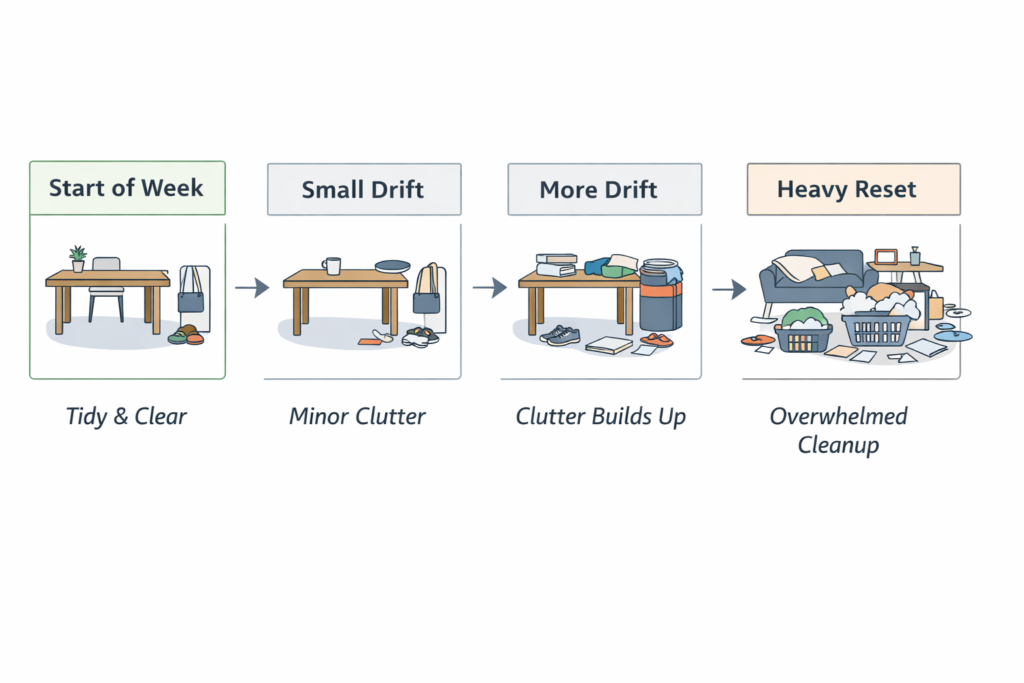
Without a Reset Point, Homes Depend on Energy
When there is no scheduled reset rhythm, maintenance depends on how you feel at the end of the day.
If energy is high, you tidy. If work runs late, you postpone. If the week is demanding, surfaces remain cluttered longer than planned. Over time, this pattern turns keeping a home organized into a reactive process.
A defined weekly home maintenance routine removes that uncertainty. It creates a fixed moment when the home returns to baseline, regardless of how uneven the week felt.
What “Neutral” Actually Means
Neutral does not mean spotless, it means functional clarity.
Floors are visible, counters are usable, key surfaces are clear, laundry is contained rather than scattered, and trash is out.
When a home returns to neutral consistently, the space feels stable even if storage is not perfect. Stability reduces the mental load at home because you are no longer carrying unfinished tasks into the next week.
A reset rhythm does not eliminate drift entirely, it prevents drift from compounding.
What a Weekly Home Reset Routine Actually Does
A weekly home reset routine does more than improve appearance. It changes how the home behaves during the week.
It Restores Visible Stability
When high-impact surfaces return to neutral consistently, the entire space feels lighter. The dining table becomes usable again. The kitchen counter stops collecting overflow. The entryway feels intentional instead of chaotic.
These visible shifts matter. They reduce visual noise, which lowers background stress. Even if deeper storage remains imperfect, surface stability changes how the home feels day to day.
A weekly reset routine focuses on leverage. You restore the areas that influence mood most quickly.
It Reduces the Mental Load at Home
When a reset happens at a predictable time, the need to monitor constantly decreases.
Instead of thinking, “We should deal with this soon,” you know there is a defined window to restore order. That awareness reduces ongoing mental tracking. The home no longer depends entirely on memory and reminders.
For busy couples, this shift is significant. A structured weekly home maintenance routine creates a shared expectation. Both partners know when stability will be restored.
It Reduces Repeated Negotiation
Without structure, tasks remain informal. One person notices, the other responds, and conversations repeat.
A reset rhythm reduces that cycle. Because the routine is defined, fewer decisions need to be negotiated in the moment. The home stops operating through reminders and starts operating through schedule.
When ownership is clear and reset windows are consistent, friction decreases naturally.
A weekly home reset routine does not eliminate work, it organizes it.
A Practical Weekly Home Reset Routine You Can Use
You do not need a complicated plan. You need structure, boundaries, and a clear stopping point.
Here is a simple weekly home reset routine that busy couples can run consistently without turning it into a deep-clean session.
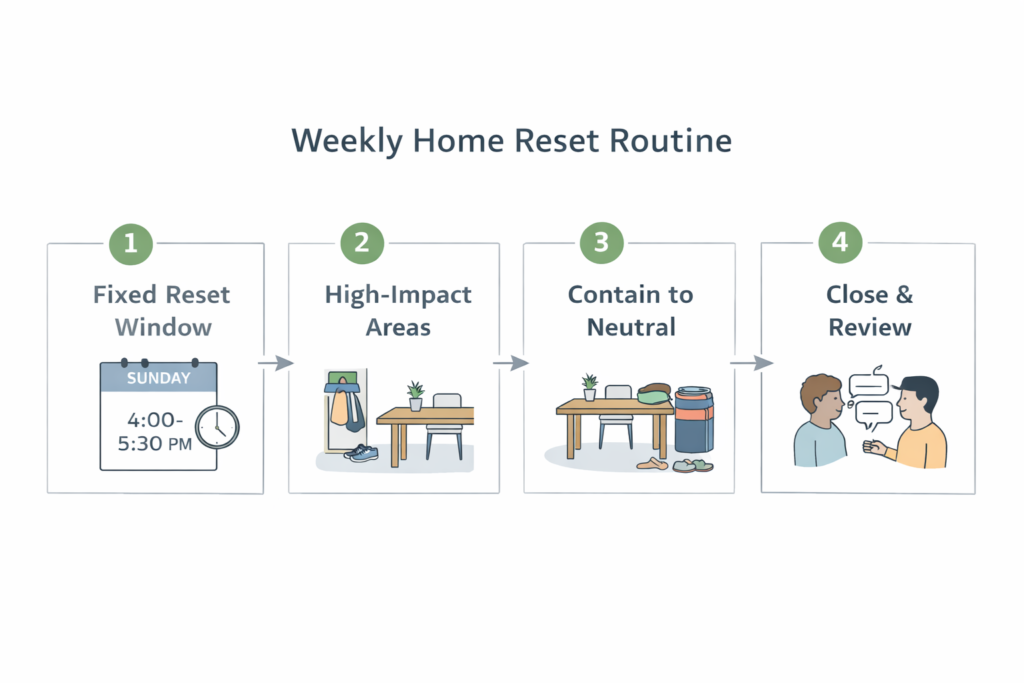
1. Choose a Fixed Reset Window
Select one consistent 60 to 90 minute block each week.
Do not leave it open-ended. Decide the day and the time. Saturday morning. Sunday evening. Midweek if necessary. The specific day matters less than consistency.
When the reset has a defined window, it stops feeling optional. It becomes part of the rhythm of the week.
2. Identify Three to Five High-Impact Areas
Before you begin, agree on the areas that most influence how your home feels.
In many homes, these include:
– Dining table
– Kitchen counter
– Entryway
– Living room surface
– Bedroom dresser
Limit yourself to three to five areas. If you try to reset everything, the routine expands and becomes unsustainable.
A weekly home maintenance routine works because it focuses on leverage, not coverage.
3. Restore to Neutral, Not Perfection
During the reset window, focus only on restoring those high-impact areas to neutral.
Return misplaced items to their correct rooms. Clear visible clutter. Run essential laundry. Take out trash. Wipe key surfaces.
Avoid reorganizing drawers. Avoid starting new projects. Avoid improving storage systems. Those tasks belong to separate sessions.
Containment restores stability. Optimization can wait.
4. Close the Reset Deliberately
Before the window ends, take five minutes to walk through the home together.
Ask:
– Which area drifted most this week?
– Did ownership feel clear?
– Does anything need adjustment next week?
This short review prevents silent friction from repeating.
When you close the reset deliberately, the home feels complete instead of temporarily managed.
How to Keep Your Weekly Reset Under Control
A weekly home reset routine only works if it stays contained. When it expands into a redesign session or a deep-clean marathon, it becomes something you avoid.
Structure protects the routine from becoming heavy.
Set a Hard Stop
Begin with a defined end time.
If you choose a 75-minute window, stop at 75 minutes. Even if one small area remains imperfect, end the session deliberately.
This boundary prevents the reset from consuming your entire weekend. A weekly home maintenance routine should feel steady, not exhausting.
Completion builds consistency.
Limit the Scope Every Time
The moment you open a drawer to reorganize or decide to “quickly” improve storage, the reset shifts from maintenance to optimization.
Keep the focus on visible stability and containment. Restore surfaces. Return items to their correct rooms. Run essential cycles.
If you notice deeper friction, make a note of it. Do not fix it during the reset window.
Scope discipline keeps the routine sustainable.
Share Leadership Intentionally
Even in a structured reset, one partner can slip into the role of quiet supervisor.
Avoid that pattern by alternating who leads the reset rhythm. One week, one partner defines the high-impact focus. The next week, the other partner leads the walkthrough and closing review.
Shared leadership distributes both visible work and mental load at home more evenly.
A weekly home reset routine should reduce negotiation, not create a new source of imbalance.
What Happens When You Skip It
Skipping one weekly home reset routine does not cause collapse. Skipping several in a row usually does.
Drift Compounds Quietly
When a reset window is missed, high-impact surfaces remain slightly unstable. A few extra items stay out. Laundry accumulates a little longer. Entry zones collect more than usual.
Because there is no defined correction point, that instability carries into the following week. What would have taken 60 minutes to restore now requires more time and more energy.
Drift rarely announces itself. It compounds.
The Reset Becomes Heavier
When several weeks pass without a reset rhythm, the next attempt feels overwhelming.
Instead of restoring three to five areas, you feel pressure to fix everything. The weekly home maintenance routine shifts into a catch-up session. That is the moment many couples abandon it entirely.
The issue is not discipline, its accumulated scope.
Install a Simple Bad-Week Version
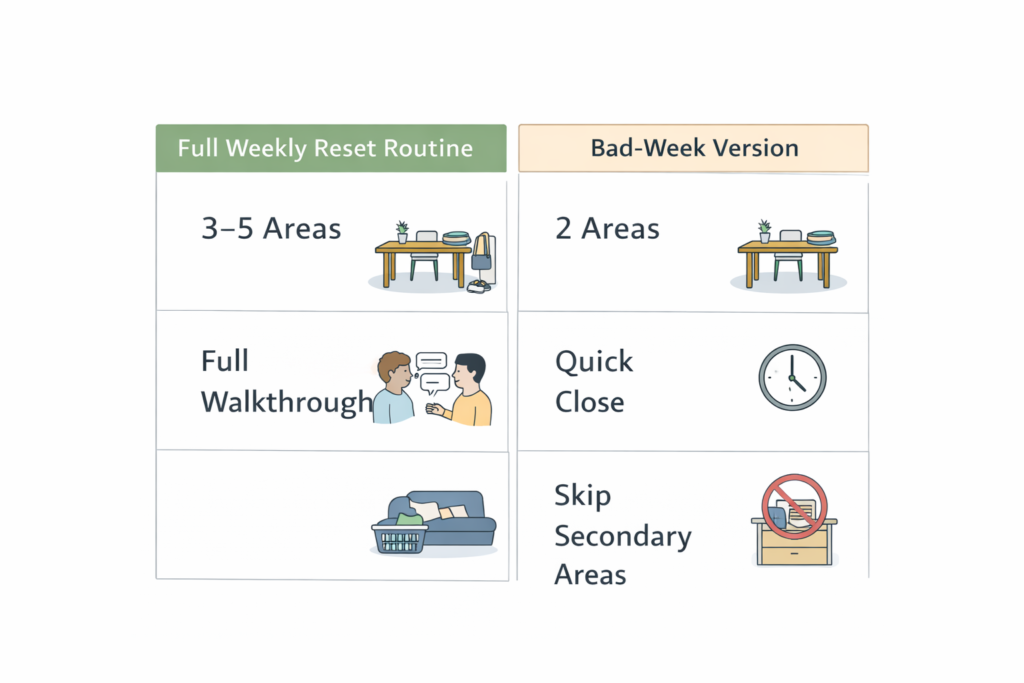
Life will disrupt your schedule. Instead of improvising under stress, define a lighter version of your reset in advance.
On a difficult week:
– Restore only your two highest-impact surfaces.
– Take out trash.
– Contain visible clutter.
Skip secondary areas.
This smaller reset maintains rhythm even when energy is low. Consistency matters more than intensity.
A weekly home reset routine survives because it adapts, not because it demands perfection.
If You Want a More Structured Version
The weekly home reset routine above is fully usable. If you run it consistently, your home will feel more stable and less reactive.
Some couples, however, find that even with a defined window, resets slowly expand. Conversations repeat. Scope creeps in. The same friction points resurface.
If you prefer a more structured version with built-in boundaries and a clearer sequence, the 90-Minute Sunday Reset provides that refinement. It breaks the reset into defined blocks, sets clear constraints, and removes ambiguity about where to begin and when to stop.
It is not more work. It is simply more guided.
You can download it here and run it this week. The best part? It’s FREE!
We’ve created the 90-Minute Sunday Reset Framework to familiarize yourself with a systems-thinking approach to resetting your home. It introduces the principles of defined scope, neutral baseline, and shared ownership in a practical way.
If, after that, you feel ready to install a more comprehensive structure across your week, the 7-Day Home Reset Framework builds it step by step. It helps you define zones clearly, assign ownership deliberately, and lock in a repeatable rhythm that prevents drift.
You can explore the full framework here.