
Table of Contents
A realistic cleaning routine for busy couples has to account for one simple truth: both of you are tired by the end of the day. Most cleaning schedules online assume spare hours, predictable energy, or one partner who can “stay on top of things.” That is not how real life feels when two full-time adults are sharing a small space.
Evenings are short. Weekends are recovery time. And when cleaning expands beyond what your energy can support, it quietly turns into tension.
The goal is not to keep your home spotless, but to keep it stable.
A realistic cleaning routine for working couples works in layers. Small daily resets prevent visible drift. A short midweek stabilizer stops Friday from feeling heavy. A structured weekly reset restores baseline control without consuming the entire weekend. When those layers work together, your home stops demanding constant attention and starts holding its shape through a normal workweek.
Why Most Cleaning Routines Fail Working Couples
Most cleaning routines are written as if time and energy are stable resources. For working couples, they rarely are. What looks reasonable on paper often collapses by Wednesday.
Unrealistic Time Assumptions
Many schedules assume someone is home during the day to reset small messes before they compound. When both partners leave in the morning and return in the evening, that buffer disappears. Dishes sit, mail waits, laundry accumulates.
If a routine depends on mid-afternoon maintenance that never happens, the entire structure begins to strain.
Perfection Standards
A lot of cleaning advice quietly equates maintenance with deep cleaning. Floors must be vacuumed thoroughly. Bathrooms must be scrubbed weekly. Every room should feel guest-ready.
That level of upkeep demands more energy than most full-time workers can consistently give. When standards remain high but energy fluctuates, burnout follows. The routine gets abandoned altogether.
No Clear Ownership
Tasks that belong to “both of us” often belong to neither in practice. When responsibility is implied instead of defined, small resets get postponed. One partner assumes the other will handle it. The other assumes it can wait.
Over time, postponement creates visible accumulation, which then requires larger effort to correct.
No Predictable Rhythm
Cleaning becomes reactive instead of scheduled. You respond to visible mess rather than following a set cadence. That reactive mode makes every reset feel urgent and heavier than it needs to be.
A realistic cleaning routine has to respect limited evening energy, shared responsibility, and the need for a predictable rhythm. Without those elements, even well-designed schedules struggle to hold.
What a Realistic Cleaning Routine Actually Looks Like
Busy couples do not need elaborate systems. They need structure that holds under real energy levels. A realistic cleaning routine works because it respects how evenings unfold, how fatigue builds, and how shared spaces accumulate small mess quickly.
The structure that works most consistently has three layers. Each layer serves a different purpose. Together, they prevent drift from compounding.
Layer 1: Daily Micro Reset (5–10 Minutes)
This is not a cleaning session. It is a containment check.
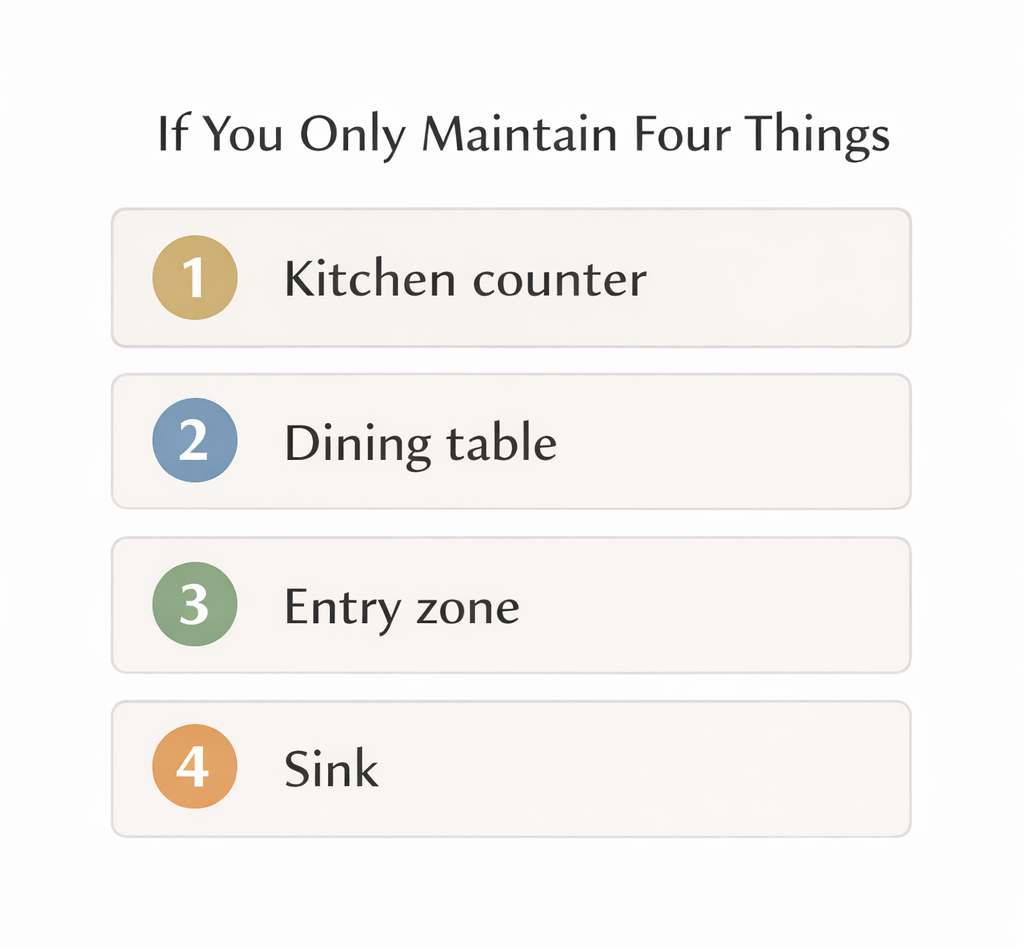
Focus only on high-visibility surfaces:
- Kitchen counter
- Dining table
- Entry area
- Sink
The goal is to restore visible neutral before bed. You are not reorganizing drawers. You are not vacuuming the entire apartment. You are clearing what affects how the space feels when you wake up.
Five to ten minutes is enough when the scope is tight. The constraint matters. When daily resets stay small, they remain sustainable.
Layer 2: Midweek Stabilizer (15–20 Minutes)
Midweek is where most routines quietly fail. By Thursday, small drift feels heavier than it should.
A short midweek stabilizer prevents that build-up. Choose one consistent evening and reset only what has drifted beyond neutral. Restore the kitchen surface. Clear the dining table. Contain laundry. Take trash out.
Do not deep clean. Do not expand scope. The purpose is stabilization, not improvement.
When this layer is consistent, weekends stop feeling like recovery missions.
Layer 3: Weekly Reset (60–90 Minutes)
The weekly reset restores baseline control. It handles shared spaces, visible floors, trash, and laundry containment in one structured window.
This is where you reset the apartment to neutral. Not spotless. Not staged. Functional and calm.
Keeping this reset contained to a defined window prevents it from taking over the entire weekend. When daily and midweek layers are working, the weekly session feels manageable rather than overwhelming.
A realistic cleaning routine is not built on intensity. It is built on rhythm. Small daily containment. Short midweek stabilization. One structured weekly reset. When those layers work together, the home stays steady without demanding constant effort.
For a detailed day-by-day breakdown, see this cleaning schedule for working couples.
Sample Realistic Weekly Cleaning Schedule for Working Couples
A routine becomes easier to follow when it lives on the calendar. The structure does not need to be complicated. It needs to be predictable.
Below is a sample schedule that fits around full-time work without turning evenings into second shifts.
Monday to Thursday: Daily Micro Reset
Each evening, anchor a five to ten minute reset to something you already do. After dinner works well. So does right before brushing your teeth.
During that window:
- Clear kitchen counters
- Empty or run the dishwasher
- Wipe the dining table
- Align the entry area
- Leave the sink empty
Stop when the timer ends. Completion matters more than expansion.
Wednesday (or Any Fixed Midweek Day): 20-Minute Stabilizer
Choose one consistent evening between Monday and Thursday. Set a timer for twenty minutes.
During this block:
- Restore any high-impact surface that drifted
- Take trash and recycling out
- Contain visible laundry
- Quick sweep of the most-used area
No reorganizing. No bathroom deep clean. The goal is to prevent Friday from carrying the weight of the entire week.
Sunday (or Another Fixed Day): Weekly Reset Window
Block a 60 to 90 minute window at a consistent time. Treat it as maintenance, not punishment.
Focus on:
- Shared living areas
- Kitchen reset
- Laundry containment
- Visible floors
- Trash removal
When daily and midweek layers hold, this weekly reset feels controlled rather than overwhelming.
The exact days can change based on your work rhythm. What matters is consistency. A realistic cleaning schedule works because it repeats, not because it expands.
How to Divide This Without Creating Tension
A cleaning routine only works if it feels fair. Not mathematically equal, but clear. Most friction in shared homes does not come from the tasks themselves. It comes from uncertainty around who initiates them.
Assign Default Ownership
Instead of saying “we’ll both handle it,” assign default owners for specific layers or zones. One partner might take the lead on kitchen neutral each night. The other might initiate the midweek stabilizer. Ownership here means initiation, not exclusivity.
When responsibility is defined, surfaces do not wait for negotiation.
Rotate Weekly If Needed
If energy levels shift or one partner carries heavier workdays, rotate roles week to week. The structure remains. The initiator changes.
Rotation prevents silent scorekeeping and keeps the system flexible without making it vague.
Install a Low-Energy Rule
Some weeks will be heavier than others. Instead of arguing in the moment, agree on a simple adjustment rule in advance.
If one partner is overloaded:
- They complete only the highest-impact task that week.
- The other handles the lighter tasks.
- Roles rebalance the following week.
Clarity reduces resentment. Improvised swaps often increase it.
Keep Conversations Short and Specific
Avoid broad debates about effort. Talk about surfaces and time windows instead.
“Can you initiate the kitchen reset tonight?” is clearer than “You never help.”
A realistic cleaning routine holds because it reduces negotiation. When daily micro resets, midweek stabilizers, and weekly windows have clear initiators, the home stays steady without turning into a running conversation.
What to Stop Doing Immediately
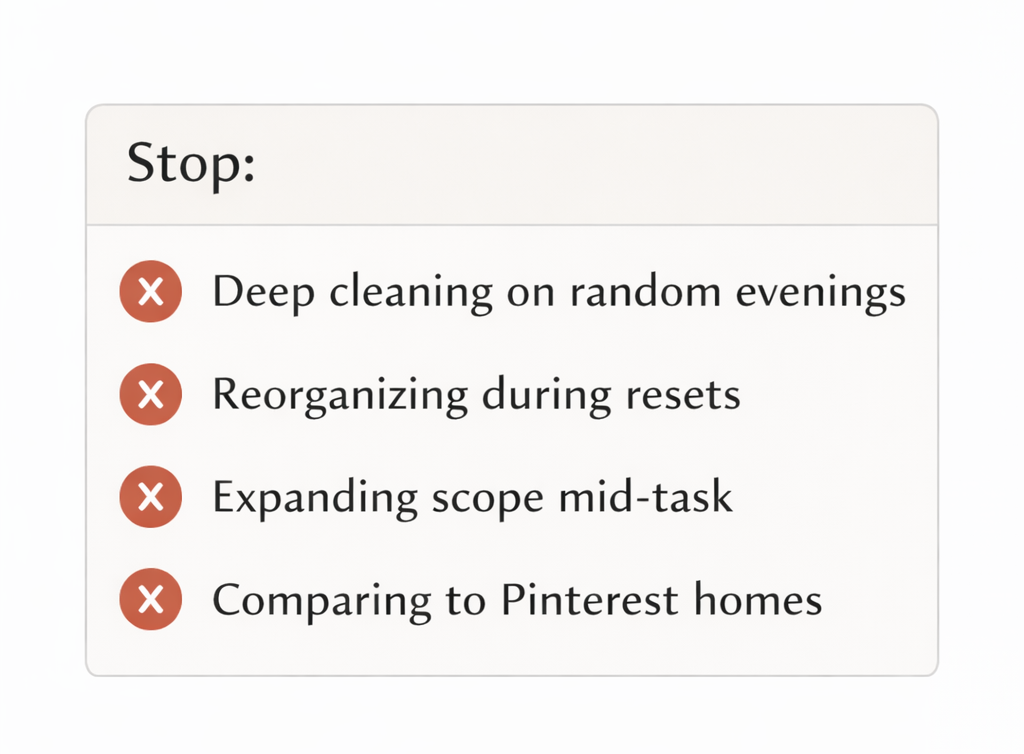
A realistic cleaning routine is as much about restraint as it is about action. Many routines fail because couples try to improve everything at once. Removing a few habits can make the structure easier to maintain.
Stop Deep Cleaning on Random Evenings
After a long workday, it is tempting to “just tackle the bathroom” or reorganize a cabinet while you are already cleaning the counter. That expansion stretches a five-minute reset into forty minutes. The next evening, you avoid starting because it feels heavy.
Containment works when it stays contained.
Stop Reorganizing During Reset Windows
Weekly resets are for restoring baseline control, not redesigning storage. When you open drawers to optimize, time disappears and energy drops.
Reorganizing has a place. It does not belong inside maintenance blocks.
Stop Expanding Scope Mid-Task
One cleared surface leads to another that looks slightly off. You notice a shelf that could be adjusted. The cycle begins.
Set a timer. Restore only what was defined for that block. When the timer ends, stop. Consistency beats intensity.
Stop Comparing to Perfect Homes
Online images create quiet pressure. Many of those homes are styled for photography or maintained under different conditions.
Your routine only needs to support your schedule and your energy. Stability matters more than aesthetics.
Removing these habits protects the structure you are building. A realistic cleaning routine works because it stays narrow, predictable, and repeatable.
Realistic Cleaning Checklist for Two Full-Time Adults
A checklist should clarify, not overwhelm. When both partners work full time, the goal is to define what “maintained” actually means. This list follows the same three-layer structure: daily, midweek, weekly.
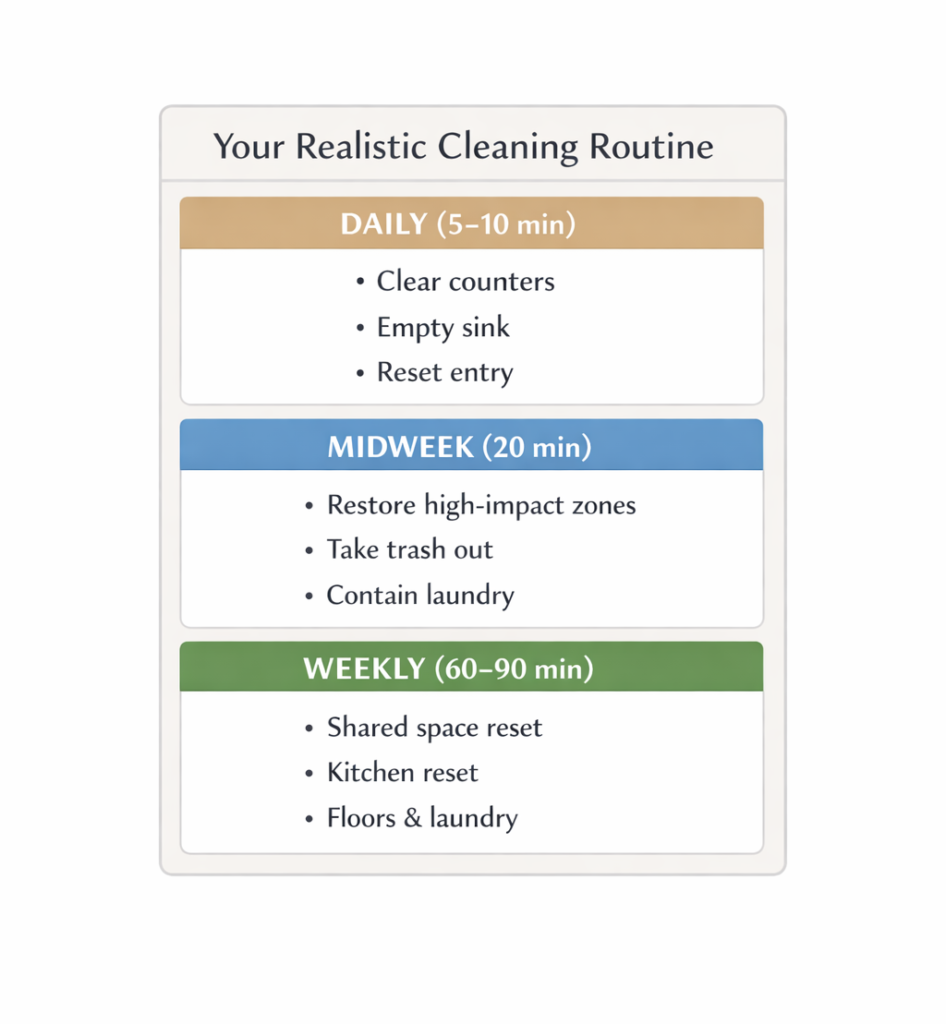
Daily (5–10 Minutes Total)
These are visible-surface tasks that influence how the home feels the next morning:
- Clear kitchen counters of non-essential items
- Load or run the dishwasher; leave sink empty
- Wipe dining table
- Align entry area (shoes, bags, keys)
- Quick visual scan of shared space
Stop when surfaces return to neutral. No expansion.
Midweek (15–20 Minutes)
Choose one fixed evening:
- Restore any high-impact surface that drifted
- Take trash and recycling out
- Contain visible laundry
- Quick sweep or vacuum of the most-used area
This block exists to prevent the weekend from absorbing the entire week’s drift.
Weekly (60–90 Minutes)
One defined window:
- Full kitchen reset (counters, sink, trash, quick fridge scan)
- Reset living and dining areas
- Start or contain laundry
- Vacuum or sweep high-traffic areas
- Bathroom surface wipe-down
This is maintenance, not deep cleaning. If something requires a longer project, schedule it separately. The weekly reset restores baseline control so the next week begins steady.
A checklist works when it reflects real capacity. For two full-time adults, fewer consistent tasks outperform ambitious plans that collapse by Thursday.
If You Live in a Small Apartment
Small apartments concentrate everything. Fewer rooms mean fewer buffers. When one surface drifts, the entire home feels affected.
In compact spaces, visibility amplifies clutter. The kitchen counter may sit within direct sight of the couch. The dining table may double as a workspace. Entry and living areas often overlap. That compression makes containment more important than volume.
Fewer Surfaces, More Pressure
Large homes can distribute small mess across multiple rooms. Small apartments cannot. A single counter absorbs mail, groceries, devices, and in-between items within hours.
Because space is limited, high-impact surfaces carry more emotional weight. Clearing them consistently matters more than deep cleaning secondary areas.
Dual-Use Zones Need Clear Boundaries
In small spaces, one surface often serves multiple purposes. The dining table might be for meals, work, and sorting. Without clear rules around when it returns to neutral, it gradually shifts into permanent storage.
Boundaries prevent that drift. Even a simple rule such as “table cleared before bed” protects shared space.
Containment Beats Optimization
In compact homes, perfect storage design matters less than friction reduction. If putting something away takes two steps instead of five, it will happen more often. If it requires shifting other items first, surfaces will win.
A realistic cleaning routine in a small apartment focuses on maintaining clear, high-visibility zones. When those remain steady, the space feels larger and calmer, even within limited square footage.
The Goal Is Stability, Not Spotlessness
A realistic cleaning routine for busy couples is not designed to impress guests or match a magazine spread. It exists to protect your time, your energy, and the tone of your evenings.
When routines aim for spotless, they demand intensity. When they aim for stability, they demand rhythm.
Stability means:
- High-impact surfaces return to neutral daily.
- Drift is interrupted midweek.
- A predictable weekly reset restores baseline control.
Nothing more dramatic than that.
If your current routine feels heavy, it is usually because scope has expanded beyond your energy. Shrink it. Tighten the layers. Keep the cadence steady.
If you would like a structured version of the weekly layer that fits into a single 90-minute window, our 90-Minute Sunday Reset walks you through it step by step. It focuses on visible surfaces, shared zones, and restoring neutral without consuming your entire weekend.
The goal is not to clean more. It is to build a routine that holds through a normal workweek.
We’ve created the 90-Minute Sunday Reset Framework to familiarize yourself with a systems-thinking approach to resetting your home. It introduces the principles of defined scope, neutral baseline, and shared ownership in a practical way.
If, after that, you feel ready to install a more comprehensive structure across your week, the 7-Day Home Reset Framework builds it step by step. It helps you define zones clearly, assign ownership deliberately, and lock in a repeatable rhythm that prevents drift.
You can explore the full framework here.