
Table of Contents
A midweek reset routine prevents the slow buildup that turns Friday evening into a catch-up session. When both partners work full time, most weekdays move quickly. Dishes stack a little higher. Laundry waits one more day. Surfaces collect small items that never fully return home. By the time the weekend arrives, the house feels heavier than it did on Monday.
The solution is not to clean more. It is to interrupt accumulation before it compounds.
A short midweek home reset, done consistently, keeps the weekly reset from expanding beyond control. It protects energy, shortens weekend maintenance, and keeps shared spaces stable during the workweek.
This guide outlines exactly what to do, how long it should take, and how to keep it contained.
Why Midweek Drift Happens
Most weeks follow a predictable pattern. Understanding it makes the reset easier to implement.
Monday Momentum
At the start of the week, the home usually feels aligned. Sunday’s reset is still holding. Counters are clear. Laundry is contained. Trash has been taken out.
There is less visible pressure.
Tuesday Delay
By Tuesday evening, small items begin to gather. A grocery bag sits longer than it should. Mail stays on the dining table. A load of laundry waits to be folded.
Each task feels minor. None demand immediate action.
Wednesday Accumulation
Midweek is when drift becomes visible. The sink fills faster. The entry area looks uneven. The trash is nearing full. The dining table no longer feels neutral.
Energy often dips around this point. Work fatigue increases. Motivation decreases.
Without intervention, Thursday and Friday absorb the buildup.
Friday Weight
By Friday, what could have taken fifteen minutes on Wednesday now requires much longer. The weekend begins with tension rather than rest.
A midweek reset routine exists to change that trajectory.
What a Midweek Reset Is (And Is Not)
Clarity prevents scope expansion.
What It Is
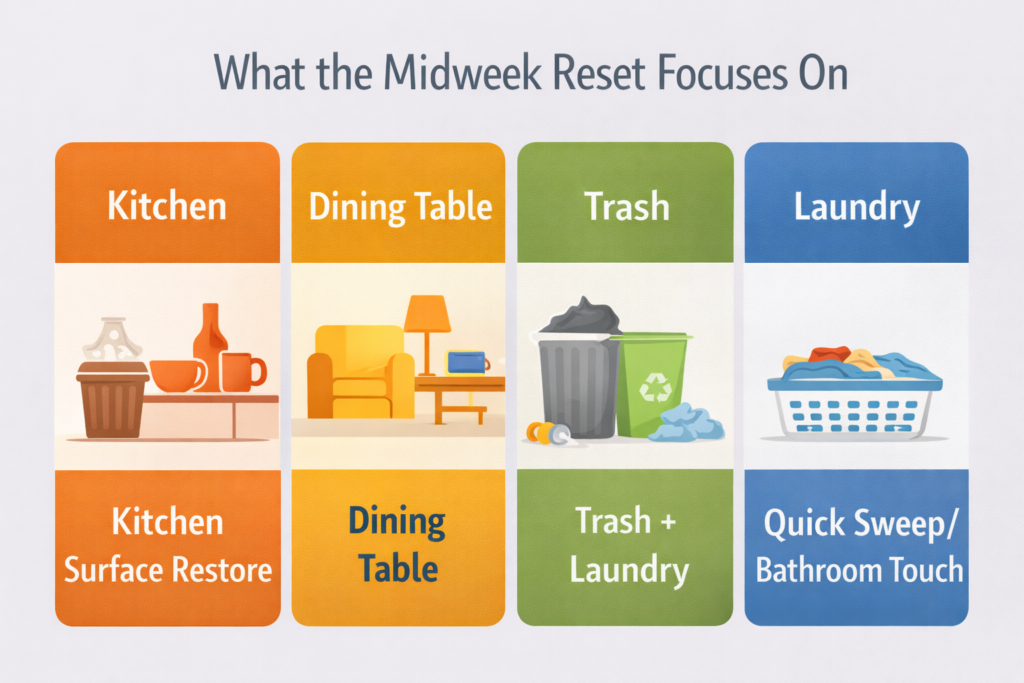
A midweek cleaning routine is:
- Surface restoration in shared areas
- Trash and recycling removal
- Laundry containment
- Quick alignment of high-traffic zones
It restores visible order without attempting deep correction.
What It Is Not
It is not:
- A deep kitchen clean
- A full bathroom scrub
- Closet decluttering
- Room-by-room reorganization
Those belong to the weekly reset or separate projects.
The midweek layer protects the week. It does not replace the weekly layer.
If you are following a daily 10-minute cleaning routine, this reset builds on that foundation. It addresses what daily containment cannot fully stabilize by Wednesday.
The 15–20 Minute Midweek Reset (Step by Step)
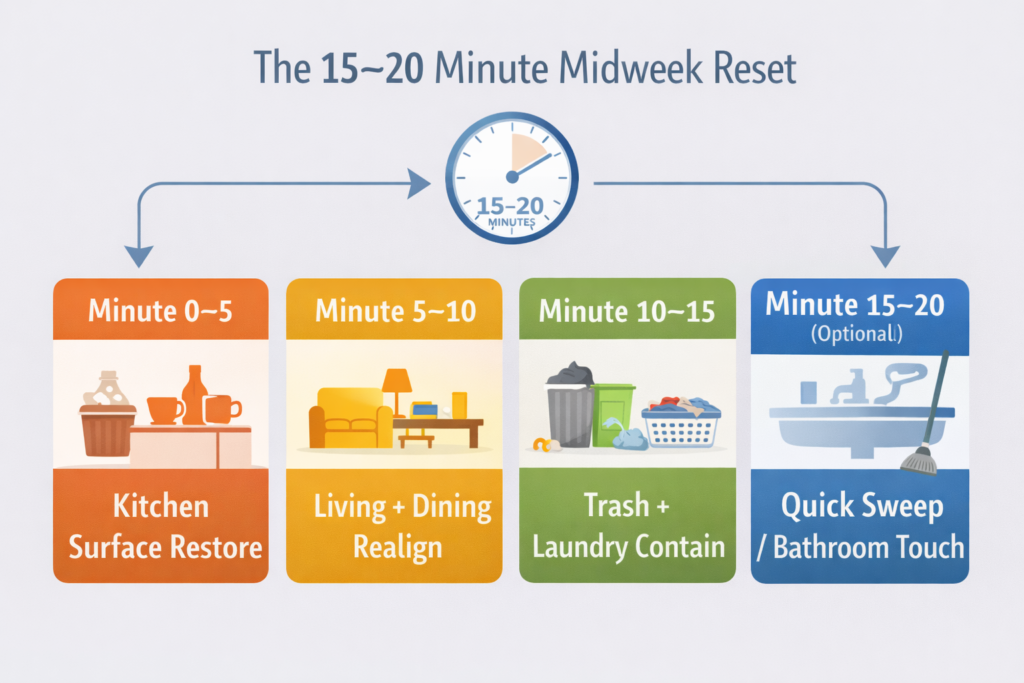
Set a timer. Move in sequence. Do not rearrange the order.
Fifteen minutes is sufficient in most homes. Allow up to twenty if laundry or trash requires slightly more time. Stop when the timer ends.
Minute 0–5: Kitchen Surface Restore
The kitchen drives visual weight.
- Clear non-essential items from counters
- Load dishwasher or stack dishes neatly
- Wipe the counter surface
- Empty trash if more than three-quarters full
Avoid cleaning inside appliances. Restore neutral and move on.
Minute 5–10: Living and Dining Realignment
Shift to the next highest-impact zones.
- Clear the dining table fully
- Return remotes, books, chargers to their usual places
- Align cushions and straighten visible surfaces
If papers or small items do not have defined homes, place them in a temporary basket. Decide later during the weekly reset.
Minute 10–15: Trash and Laundry Containment
Midweek clutter often hides in these two categories.
- Take out trash and recycling
- Collect visible laundry into one contained area
- Start one load if necessary
The goal is not to complete all laundry. It is to prevent scattered buildup.
Minute 15–20 (Optional): Quick Bathroom and Floor Touch
If time remains:
- Wipe bathroom sink surface
- Align toiletries
- Quick sweep of high-traffic floor area
Keep it light. Do not scrub or expand.
When the timer ends, stop.
When to Schedule the Midweek Reset
Consistency matters more than the specific day.
Fixed-Day Approach
Many couples find Wednesday effective. It sits at the midpoint of the workweek and prevents Thursday fatigue from carrying visible clutter forward.
Choose one evening and protect it. Anchor it after dinner or before winding down.
Trigger-Based Approach
If work schedules are unpredictable, use a trigger instead of a fixed day:
- First evening both partners are home before 8 PM
- When trash reaches a defined level
- When dining table loses neutral
The reset still happens once midweek. Only the timing flexes.
If One Partner Is Overloaded
During heavier work weeks, adjust responsibility rather than canceling the reset.
- One partner initiates and completes the reset
- The other compensates during the weekly session
Avoid skipping entirely. Momentum matters.
If division of labor creates friction, review your chore ownership structure and define initiators in advance. Clear responsibility reduces midweek hesitation.
Why These 20 Minutes Change the Weekend
A midweek reset routine does not eliminate the need for a weekly reset. It reduces its weight.
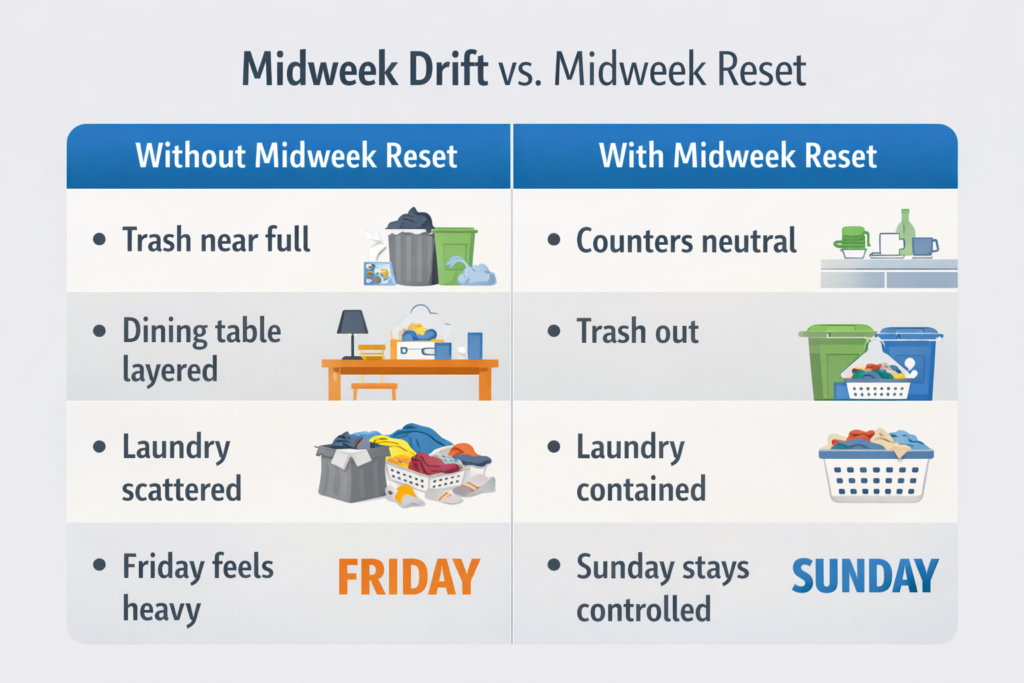
Without a midweek interruption:
- Trash accumulates
- Laundry spreads across rooms
- Surfaces drift further from neutral
- The weekly session expands
With midweek containment:
- Weekly reset remains focused
- High-impact areas need less correction
- Sunday feels structured rather than reactive
In homes without this layer, the weekend often absorbs five days of visible drift. In homes with this layer, the weekend restores baseline rather than recovering from neglect.
If you are following a cleaning schedule for working couples, this midweek block protects that schedule from collapse.
Common Mistakes During Midweek Resets
Small boundary violations undermine consistency.
Expanding Scope
Starting with the counter and ending up reorganizing a pantry cabinet stretches the reset beyond its limit. Keep it surface-focused.
Cleaning When Exhausted
If both partners are depleted, scale down to kitchen and trash only. Resume full sequence the following week. Partial completion is better than abandonment.
Treating It as Optional
When the midweek reset feels negotiable, it eventually disappears. Protect it as part of the structure.
If You Skip the Midweek Reset
Some weeks will disrupt routine. Travel, deadlines, and illness happen.
If one week is missed:
- Keep daily resets active
- Shorten the weekly reset to focus on high-impact surfaces
- Resume the midweek layer the following week
Do not attempt to double the duration midweek the next week. Maintain original timing.
Skipping repeatedly usually signals scope creep or poor timing. Reassess day selection rather than abandoning the layer.
Small Adjustment, Significant Stability
A midweek reset routine works because it respects capacity. It interrupts buildup while energy still allows containment. It prevents Friday from becoming a corrective session.
Protect fifteen to twenty minutes. Follow the sequence. Stop when the timer ends.
When paired with a daily 10-minute reset and a structured weekly block, this layer completes the maintenance cycle. The home remains steady without demanding constant attention.
If you want to see how this fits into the full layered system, review the realistic cleaning routine for busy couples or the detailed weekly cleaning schedule that builds around it.
Stability rarely comes from intensity. It comes from interruption at the right time.
If you want a structured walkthrough of the full weekly layer that this midweek reset supports, the 90-Minute Sunday Reset guide lays it out clearly. It shows how daily containment, a short midweek stabilizer, and one defined weekly session work together without expanding your evenings.
For a more detailed system that includes zone breakdowns, ownership planning, and a repeatable framework for two full-time adults, the Done By Sunday 7-Day Home Reset Framework expands this into a complete maintenance plan. It is built for real workweeks and designed to hold under normal pressure.