
Mental load in relationships rarely shows up as a dramatic problem. Most couples contribute, most homes function, the friction builds quietly.
One partner tends to remember more. To anticipate more. To initiate more. Over time, that invisible layer of responsibility begins to feel uneven, even when visible chores appear shared.
This article looks at mental load structurally. Not as a personality flaw or as a motivation issue, but as a systems problem that can be redesigned.
Table of Contents
What “Mental Load” in Relationships Actually Means
When people talk about mental load in a relationship, they usually describe a feeling before they describe a structure. It feels like carrying more, remembering everything, and being the default organizer of the home. But beneath that feeling, there is a pattern.
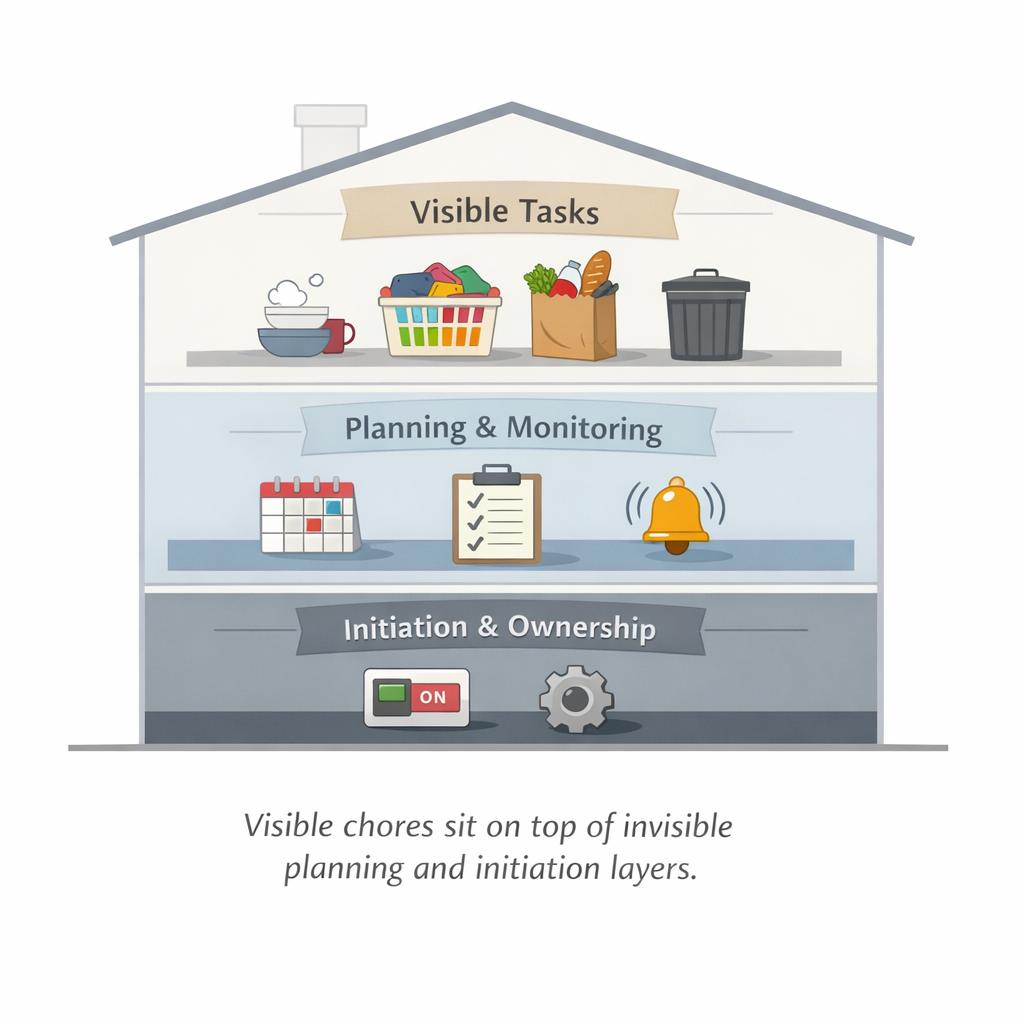
Mental load is not the physical act of doing chores. It is the ongoing responsibility of anticipating, tracking, and initiating what needs to happen so a home functions smoothly.
In most shared homes, the visible work is easy to measure. Dishes are washed, laundry is folded, groceries are bought. But the invisible layer that makes those actions happen is rarely named. Someone notices the milk running low before it becomes a problem. Someone keeps track of when the school form is due. Someone realizes that the dog’s medication needs to be reordered this week rather than next.
That invisible layer is where mental load lives.
The Planning Layer
Planning is the forward-looking part of responsibility. It means thinking ahead so friction does not appear later. Planning meals before the week begins, scheduling appointments before they become urgent, coordinating work calendars with school events. None of these actions are dramatic, but they prevent disruption.
When one partner consistently carries the planning layer, they become the quiet architect of stability. If they stop planning, the system does not collapse immediately, but it begins to wobble.
Planning is not to achieve perfection. You need it to maintain a predictable baseline.
The Monitoring Layer
Monitoring is different from planning. It is the background scanning that runs almost constantly. Are we low on paper towels? Has the utility bill been paid? Did the teacher send an update that requires a response? Is the car due for service soon?
Monitoring rarely appears on a couples chore list because it does not look like a task. It looks like awareness. But awareness requires attention, and attention consumes energy.
In many relationships, one partner becomes the primary monitor. They carry a mental dashboard of the home. The work is subtle, but the cognitive weight is real.
The Initiation Layer
Initiation is the trigger point of action. It answers the question: who notices that something needs to start.
Two people may both be willing to do the groceries and of of paying bills. But if only one person consistently initiates those actions without being prompted, that person carries more mental load even if the execution is shared.
Initiation is often mistaken for “just being more organized” or “naturally better at managing things.” In reality, it is structural. When initiation defaults to one partner, mental load accumulates even if the physical work appears evenly split.
Mental load, then, is not a personality trait. It is not about who cares more. It is the byproduct of a system where planning, monitoring, and initiation have not been made explicit.
Once you see those layers clearly, the conversation shifts. The question stops being “Who is doing more?” and becomes “How is responsibility structured?”
Why Mental Load in Relationships Accumulates Quietly
Mental load rarely appears overnight. It builds gradually, almost invisibly, because most couples begin with good intentions. Both partners contribute. Both step in when needed. Both assume things will balance out naturally.
The imbalance does not begin with effort. It begins with ambiguity.
When responsibility is shared loosely, without default ownership, tasks begin to float between two capable adults. In the short term, this feels flexible. In the long term, it creates drift.
Shared Responsibility Without Default Ownership
In many homes, responsibilities are described as “shared.” Groceries, bills, school logistics, and cleaning are all shared. But shared without structure often means undefined.
If a task belongs to both people, it frequently belongs to neither in a concrete way. Someone eventually notices that it needs attention. Someone eventually initiates it. Over time, that “someone” becomes predictable.
The partner who initiates most often slowly becomes the default operator of the home, even if that role was never explicitly assigned.
This is not about willingness, but about trigger clarity. When the trigger is unclear, the same person absorbs it repeatedly.
The “Whoever Notices” Trap
Many couples operate on an unspoken rule: whoever notices the task first handles it.
On the surface, this feels fair. In practice, noticing is not evenly distributed. The person who monitors more will notice more. The person who plans ahead will detect gaps earlier. The person who worries about consequences will intervene faster.
Over time, “whoever notices” becomes structurally biased toward the partner who is already carrying more awareness.
The trap is subtle because the physical work may still be shared. One person might cook while the other shops. One person might fold laundry while the other washes it. But if one partner consistently initiates and tracks, the mental layer remains uneven.

Memory as Infrastructure
When no ownership structure exists, homes rely on memory. Someone remembers that trash day is tomorrow. Someone remembers to check the school portal. Someone remembers that the detergent is almost finished. These reminders become the invisible infrastructure holding the system together.
Memory is unreliable infrastructure.
It depends on mood, energy, stress levels, and bandwidth. During calm weeks, it functions smoothly, while during busy or stressful weeks, it strains.
When one partner becomes the primary memory-holder of the household, they are effectively acting as the operating system. They are the scheduler, the monitor, and the initiator. If they become overloaded, tasks slip not because of laziness, but because the system depended too heavily on one person’s mental bandwidth.
This is how mental load accumulates quietly. There is no dramatic event, no open conflict at first. There is simply gradual drift toward one person carrying more of the cognitive structure of the home.
Until that structure is made visible, it remains personal. Once it is visible, it becomes structural.
Why Couples Chore Charts and Fairness Talks Don’t Fix It
When couples realize that mental load feels uneven, they usually try something practical. They make a list, divide tasks, and talk about fairness. These steps are reasonable. They often help temporarily.
But in many homes, the imbalance returns.
The reason is structural. Most solutions divide execution without redesigning initiation, load measurement, or maintenance rhythm.
Division Without Initiation Clarity
A chore chart typically answers one question: who performs which task. It does not answer a more important question: who initiates it.
Two partners may agree that groceries are “shared.” One cooks, the other shops. On paper, that appears balanced. In practice, if one partner is always the person who notices that groceries are needed and prompts the shopping, initiation remains centralized.
Execution can be divided while mental load remains concentrated. Without explicit initiation ownership, tasks continue to float until one person triggers them. Over time, that trigger role hardens into an invisible responsibility.
Equality Without Load Calibration
Many fairness conversations focus on visible equality. Each partner gets a similar number of tasks. The list looks balanced.
But tasks do not carry equal weight.
Some responsibilities are routine and predictable. Others require coordination, planning, or emotional bandwidth. Some occur daily. Others occur monthly but create high friction when they do.
If division ignores frequency and cognitive weight, one partner may carry fewer tasks but more strain. Another may carry more tasks but less friction.
Without calibrating for time, recurrence, and mental load, equality on paper does not translate to stability in real life.
Renegotiation Without Rhythm
When imbalance resurfaces, couples often renegotiate in the moment. A midweek conversation happens, tasks are swapped reactively, and adjustments are made under stress.
This creates movement without stability.
Without a defined rhythm for review, renegotiation becomes emotional rather than procedural. Small issues escalate because there is no scheduled space to adjust structure calmly.
The result is predictable. The system drifts again.
Couples chore charts fail not because couples lack effort. Fairness talks fail not because partners lack goodwill. They fail because they treat mental load as a behavioral issue rather than a structural one.
When ownership, load calibration, and review rhythm are not explicitly installed, drift returns quietly, even in well-intentioned homes.
The Structural Fix: Installing Ownership Infrastructure
If mental load accumulates because responsibility drifts, then the solution is not more reminders or better intentions. It is clearer infrastructure.
Most homes already have effort. What they lack is structure around visibility, ownership, load calibration, and maintenance rhythm.
Installing responsibility infrastructure does not require a personality change. It requires clarity.
There are four structural shifts that stabilize shared homes.
1. Make Responsibility Visible
Before anything can be divided fairly, it has to be seen fully.
In many households, only physical tasks are listed. Cleaning, cooking, trash, laundry. But the invisible layer, like planning, monitoring, coordinating, tracking is rarely mapped.
When invisible responsibilities stay invisible, they default to the person who naturally carries them.
Visibility changes the tone of the conversation immediately. Once both partners can see the full recurring structure of the home, the discussion moves away from impressions and toward shared reality.
Visibility is not about blame, but about coverage. If something happens regularly, it belongs on the map.
2. Assign Default Ownership
Once everything is visible, the next shift is clarity of initiation.
Every recurring responsibility needs a default owner. Not a dictator or a permanent burden, simply a primary trigger.
Default ownership answers one question: who notices when this needs to happen?
Execution can still be shared. Help can still be offered. But initiation and tracking sit with one clearly defined person.
When ownership is explicit, tasks stop floating. The cognitive layer begins to distribute more evenly because initiation is no longer assumed.

3. Calibrate Real Load
Not all responsibilities weigh the same. A five-minute task that happens daily can carry more cumulative load than a one-hour task that happens monthly. A short task that requires coordination or emotional effort can feel heavier than a longer routine task.
Calibrating load means looking at frequency, time, and friction together rather than counting tasks blindly.
When couples evaluate total structural load instead of just visible chores, conversations become grounded. Adjustments become deliberate rather than reactive.
The goal is not perfect symmetry, it is sustainable balance.
4. Install a Weekly Alignment Rhythm
Even a well-designed structure drifts without maintenance.
Work schedules shift, children’s activities change, energy levels fluctuate. Without a predictable review rhythm, small changes accumulate quietly.
A short, structured weekly alignment prevents that accumulation.
The rhythm does not need to be long. It simply needs to be consistent. It creates a defined space where ownership can be reviewed calmly instead of renegotiated midweek.
When visibility, ownership, load calibration, and rhythm exist together, mental load stops being personal. It becomes procedural.
And procedural problems are easier to solve.
What Structural Stability Actually Feels Like
When responsibility becomes structured, the shift is rarely dramatic. There is no grand announcement that the system is working. Instead, the tone of daily life changes in small but noticeable ways.
The first change is predictability.
Tasks no longer rely on reminders or subtle prompts. Groceries happen because they belong to someone. School communication gets reviewed because it has a default owner. Trash goes out because initiation is defined. The system begins to run without constant verbal coordination.
The second change is reduced mental tracking.
One partner is no longer carrying an internal checklist for everything that might fall through. The cognitive dashboard that used to sit in one person’s head becomes externalized and shared. That alone reduces friction more than most couples expect.
The third change is shorter conversations.
When something slips, the discussion is specific. It references structure rather than personality. Instead of “You never remember,” the conversation becomes “This task may need a clearer trigger” or “The load might need adjustment.” The tone shifts from accusation to calibration.
The fourth change is emotional neutrality around routine tasks.
When responsibility feels predictable, everyday logistics stop feeling symbolic. Paying a bill or scheduling an appointment no longer carries hidden meaning about care, effort, or commitment. It becomes part of the system rather than a reflection of character.
Structural stability does not eliminate busy weeks. It does not remove stress. It does something quieter and more valuable. It ensures that responsibility does not depend on one person’s memory or energy in order for the home to function.
That is what sustainable balance feels like.
When to Install a Structural System
Not every home needs a full redesign. Some imbalances are temporary. Some weeks are simply heavy.
A structural system becomes necessary when patterns repeat.
If one partner consistently carries the remembering, even when execution is shared, that is structural.
If conversations about chores keep resurfacing every few months, that is structural.
If tasks are divided but mental load still feels uneven, that is structural.
If you have tried chore charts, apps, or informal agreements and the imbalance quietly returns, that is structural.
The signal is not conflict. It is repetition.
When the same friction resurfaces despite effort and goodwill, the issue is usually not motivation. It is infrastructure.
Installing ownership clarity, calibrated load, and a defined alignment rhythm does not require overhauling your home. It requires formalizing what has been informal.
For couples who prefer structure over repeated negotiation, a shared operating system provides that clarity.
Responsibility Architecture™ was designed for this layer. Not for cleaning or decluttering. It is for the invisible structure underneath both.
When responsibility is visible and ownership is explicit, mental load stops accumulating quietly. It becomes measurable, adjustable, and sustainable.