
Table of Contents
If you have ever felt tired in your own home without being able to explain why, you may be carrying more of the mental load at home than you realize.
In many busy couples, both partners contribute and both genuinely care about how the home functions. Yet one person often ends up tracking the invisible details. They remember what needs restocking, notice when routines begin to slip, and anticipate small issues before they turn into larger ones.
Nothing looks dramatic from the outside. The house may even seem fine. But constantly monitoring what needs attention creates a quiet strain over time.
This does not happen because one person works harder. It usually happens because the structure underneath is unclear.
Why the Mental Load at Home Often Shifts to One Partner
The mental load at home rarely divides itself evenly. It tends to settle with the person who notices patterns first and feels responsible for preventing disruption.
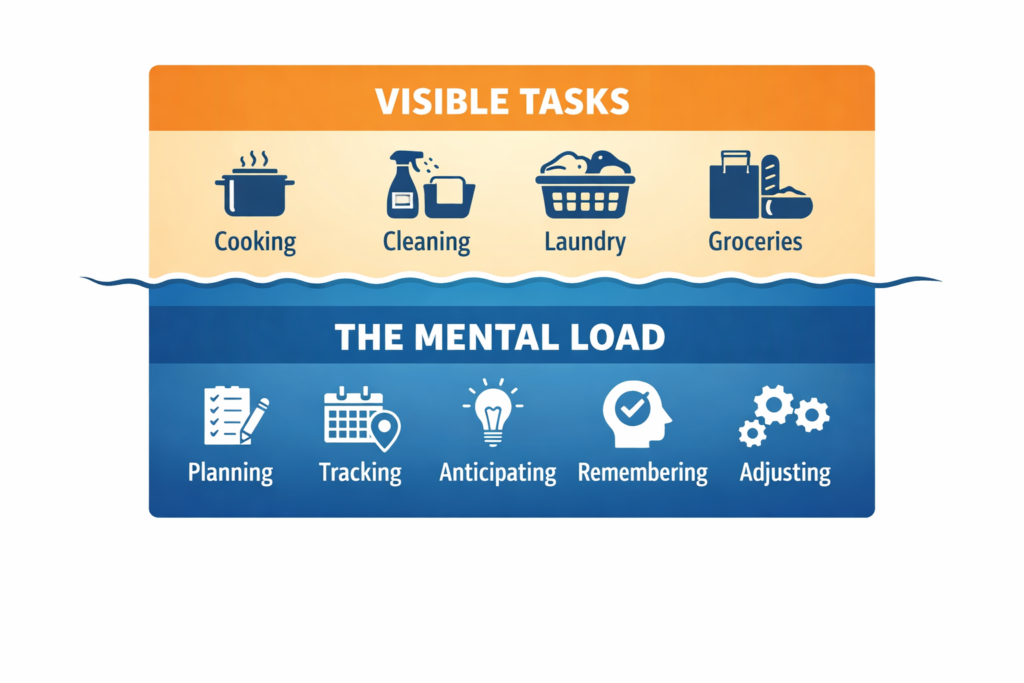
In many couples, one partner becomes more attuned to the state of the environment. They register when laundry is close to overflowing or when the fridge is almost empty. They keep track of school schedules, upcoming commitments, and small household details that keep the week running smoothly. Over time, that attentiveness turns into ongoing oversight.
Recent research published by the Institute of Family Studies has suggested that cluttered home environments can correlate with higher stress responses for women compared to men. While every relationship is different and no pattern applies universally, the finding highlights something important. When the environment feels unstable, stress does not always distribute equally. Awareness and responsibility often move together.
This shift usually happens gradually. No one assigns the role formally. It grows through habit. One partner steps in more often, remembers more often, and anticipates more often. The other partner may still contribute meaningfully, yet the background tracking remains concentrated.
Without clear ownership and a defined reset rhythm, someone continues to carry the overview of the system. That ongoing vigilance becomes the weight people describe when they talk about the mental load at home.
Why Dividing Chores Does Not Automatically Reduce Mental Load
Many couples respond to imbalance by trying to divide chores more evenly. On paper, that seems reasonable. In practice, it does not always reduce the mental load at home.
Task Sharing vs Cognitive Ownership
A task can be shared while the thinking behind it remains concentrated.
For example, one partner may cook dinner while the other cleans up. Yet the same person might still be deciding the weekly menu, checking what needs to be restocked, and remembering upcoming schedule conflicts. The physical effort appears balanced, but the planning layer stays uneven.
When dividing household chores fairly focuses only on visible labor, the invisible tracking often remains untouched.
When Responsibility Is Reactive
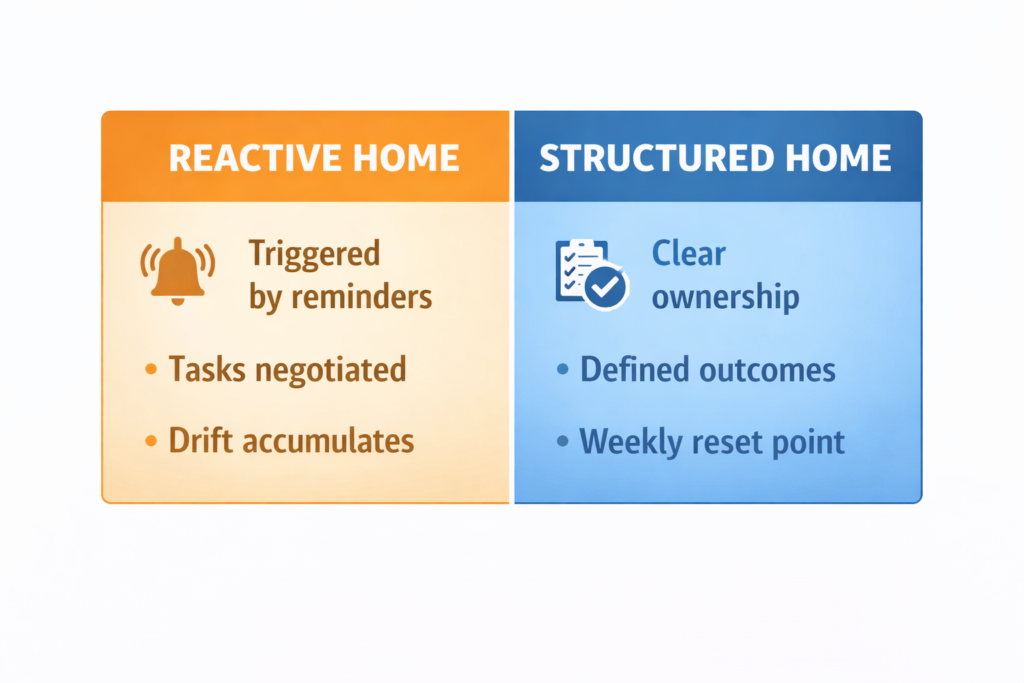
In many homes, tasks are triggered by reminders.
Someone says the trash is full.
Someone asks whether the laundry has been switched.
Someone points out that groceries are running low.
Even if both partners respond positively, the responsibility for noticing still rests with one person. That noticing becomes ongoing mental work.
Without clear ownership of outcomes and timing, responsibility remains reactive. The person monitoring the system continues to carry the overview.
Why Good Intentions Are Not Enough
Most couples operate with goodwill. If something needs doing, someone will eventually handle it. That approach works during calm weeks. It becomes strained when work intensifies or schedules shift.
A home maintenance system absorbs those fluctuations. Informal coordination does not.
When dividing chores does not address ownership, reset rhythm, and outcome clarity, the mental load at home remains uneven even if tasks appear balanced.
How to Reduce the Mental Load at Home Structurally
Reducing the mental load at home requires more than redistributing tasks. It requires shifting how the home operates.
When structure improves, background vigilance decreases. The goal is not to monitor better. It is to design a system that requires less monitoring.
Clarify Outcomes Before Assigning Tasks
Start by defining outcomes clearly.
For example, instead of saying “handle laundry,” define what finished laundry means in your home. Does it include folding and putting clothes away? Does it include checking whether detergent needs restocking? Does it include preparing uniforms for the week ahead?
When outcomes are specific, expectations stop living in one person’s head.
Clarity reduces silent tracking.
Assign Full Ownership, Not Partial Help
Once outcomes are defined, assign full ownership to one person.
Full ownership includes planning, remembering, executing, and correcting. It also includes deciding when during the week the task fits best.
This does not eliminate collaboration. It removes ambiguity.
When ownership is complete, the mental load at home spreads more evenly because the overview is no longer concentrated in one place.
Create a Predictable Weekly Reset Point
Even well-defined systems drift when life becomes busy. That is normal.
What prevents drift from turning into resentment is a predictable weekly reset routine. During that reset, you briefly review what worked, what slipped, and whether ownership still feels fair.
This reset does not need to be long. It needs to be consistent.
When a home has a defined correction point, the mental layer becomes lighter. No one has to carry the entire system in their head because the system has a built-in moment of realignment.
If You Need a Clear Starting Point
If the mental load at home feels heavy right now, you do not need to redesign everything at once.
Often, the hardest part is not dividing tasks. It is stepping out of reactive mode long enough to see the structure clearly.
That is why we created the 90-Minute Sunday Reset. It gives you a defined window to re-establish baseline clarity, align on ownership, and reduce the most visible friction without turning the entire weekend into a project.
For some couples, that focused reset creates enough stability to lighten the mental layer immediately.
When You’re Ready to Formalize the System
As you begin clarifying ownership and defining reset points, you may notice deeper patterns. Certain tasks repeat. Certain responsibilities remain unclear. Drift returns during busy weeks.
If you want a more deliberate framework, the 7-Day Home Reset builds the structure more thoroughly. Over one focused week, it helps you define outcomes, assign ownership clearly, and establish a repeatable weekly reset rhythm so the mental load does not quietly return.
Reducing the mental load at home does not require perfection. It requires shared architecture.
When structure becomes visible, responsibility becomes clearer. And when responsibility is clear, the home feels lighter for both of you.