
Most daily, weekly, monthly cleaning schedules look good on paper. They feel organized, complete, even motivating. And then life begins. Work spills over, energy dips midweek, and by Thursday the schedule is quietly abandoned.
This does not happen because people lack discipline. It happens because most schedules are built like lists, not systems.
A list assumes consistency. A system absorbs inconsistency.
What you need is not a longer daily, weekly, monthly cleaning schedule checklist. You need a structure that holds even when the week does not go according to plan. This guide builds that structure using a layered approach that matches how real homes behave, not how ideal homes are imagined.
Table of Contents
Why Most Daily, Weekly, Monthly Cleaning Schedules Fail Within Days
Most people have tried some version of a cleaning schedule before. The failure pattern is familiar. Strong start, gradual drift, quiet abandonment. The reasons are consistent.
Everything Feels Important
Traditional schedules treat every task as equally necessary. Vacuuming, wiping counters, organizing drawers, deep cleaning appliances all sit on the same level. There is no hierarchy.
When everything is important, nothing is prioritized. The result is cognitive overload. You look at the list, feel behind before you begin, and postpone starting.
A functional system distinguishes between what maintains order and what improves it. Those are not the same thing.
No Time Constraints
Most schedules define what to do but not how long it should take. That small omission creates a large problem.
Tasks expand. A quick kitchen reset turns into reorganizing cabinets. Folding laundry becomes sorting wardrobes. What should take 20 minutes quietly consumes an hour.
Without time boundaries, cleaning becomes open-ended. Open-ended work competes poorly with real life.
No System Between Days
Daily, weekly, and monthly tasks are usually presented as separate buckets. There is no connection between them.
Daily cleaning does not reduce weekly effort. Weekly cleaning does not prevent monthly overload. Each layer operates in isolation.
A sustainable home requires coordination across these layers. Otherwise, work repeats unnecessarily and effort compounds instead of stabilizing.
Life Disrupts Static Plans
Most schedules assume a stable week. Real weeks are uneven.
Some days you return home late. Some weeks one partner has lower energy. Some weekends disappear into social or family commitments.
When a schedule does not account for variability, it breaks under normal conditions. Once broken, it is rarely resumed.
The Three-Layer System That Actually Works
A home that stays clean over time does not rely on intensity. It relies on layering.
Each layer in the realistic cleaning routine for busy couples solves a different problem. When the layers are clear, the system becomes lighter, not heavier.
Layer 1: Daily Neutral (5 Minutes)
This layer prevents visible chaos from forming.
Daily neutral focuses only on high-impact surfaces. It is not a full clean. It is a reset of what your eyes register first when you enter a room.
Typical actions include clearing the dining table, wiping the kitchen counter, and resetting the entry area.
The goal is simple. Restore visual calm in five minutes. Stop when the timer ends.
Layer 2: Weekly Reset (90 Minutes)
This layer restores the home to baseline.
Even with daily containment, some drift accumulates. The weekly reset clears that drift and returns key zones to neutral.
The focus remains on shared spaces, the kitchen, and bedroom surfaces. This is not a deep cleaning session. It is a controlled reset with clear boundaries.
Layer 3: Monthly Deep Stabilization
This layer corrects what the other two layers do not address.
Over time, storage fills up. Friction points emerge. Some areas require deeper cleaning that does not belong in a weekly cycle.
Monthly work includes clearing overfilled storage, removing friction items, and completing deeper cleaning tasks in small, focused blocks.
Your Daily Cleaning Schedule (5-Minute Version That Holds)
Daily cleaning is often misunderstood. It is not about maintaining the entire house. It is about preventing visible disorder from spreading.
What to Include (3 Actions Only)
Limit daily actions to three. More than that creates resistance.
Choose surfaces that influence how the home feels immediately. Clearing the dining table, resetting the kitchen counter, and restoring the entry area are usually enough.
These are leverage points. When they are clear, the home feels under control even if other areas are imperfect.
What to Ignore
Daily cleaning should exclude floors beyond obvious mess, storage areas, and deep cleaning tasks.
Trying to include everything is what breaks consistency. Daily neutral works because it is selective.
The Trigger Rule
Daily actions must be tied to an existing habit.
After dinner or before bed works well. A fixed trigger removes decision-making and keeps the action automatic.
Your Weekly Cleaning Schedule (The Real Reset)
The weekly reset is where the home returns to a stable baseline. It is the anchor of the entire system.
The 90-Minute Structure
Divide the reset into clear blocks.
Start with a quick sweep to remove visible clutter. Move into shared spaces, then the kitchen, and finish with bedroom and laundry surfaces.
This sequence maintains flow and prevents fragmentation.
The Surface-First Rule
During the reset, focus only on visible surfaces.
Do not reorganize drawers or redesign storage. Surface clarity creates immediate impact and keeps the reset efficient.
The No-Spiral Rule
Avoid expanding tasks across rooms.
If you carry something into another room, place it and return. Do not begin new work there. This keeps the reset contained.
What “Done” Actually Means
Completion is defined as neutral.
Surfaces are clear, the sink is empty, and clutter is contained. It does not mean perfect or styled.
Stopping at neutral ensures the system remains sustainable.
Your Monthly Cleaning Schedule (What Actually Belongs Here)
Monthly cleaning is often overloaded with unnecessary tasks. In a functional system, it has a specific role.
Storage Reset
Identify areas where storage has become difficult to use.
Remove expired items, duplicates, and anything blocking normal access. The goal is usability, not redesign.
Deep Cleaning Blocks
Some tasks require less frequency but still matter.
Bathroom deep cleaning, appliance maintenance, and fridge resets fit here. Limit this to one or two areas per month.
System Adjustments
This is where you refine the system itself.
Observe where clutter appears first and adjust containment rules instead of increasing effort.
How to Combine Daily, Weekly, and Monthly Without Burnout
This is where most systems fail. The layers begin to overlap, and work multiplies.
The Layering Rule
Each layer has a distinct purpose. Daily prevents drift, weekly restores baseline, and monthly fixes friction.
When roles are clear, work becomes lighter.
The Non-Overlap Rule
Do not perform the same task across multiple layers.
If surfaces are handled daily, weekly resets should not redo them unnecessarily. If storage is handled monthly, weekly work should not expand into it.
The Time Cap Rule
Time constraints keep the system intact.
Daily stays at five minutes. Weekly stays at ninety. Monthly remains limited to one or two focused sessions.
A Realistic Cleaning Schedule Example (Busy Couple Version)
This is how the system operates in real life.
Weekday Flow
Each day includes only the daily neutral actions. No expansion.
Midweek Containment
One short session midweek restores any drift beyond neutral.
Sunday Reset
A fixed ninety-minute block restores the home fully.
Monthly Slot
One scheduled session handles deeper cleaning or storage corrections.
The One Mistake That Breaks Every Cleaning Schedule
Most systems do not fail because of neglect. They fail because of expansion.
Turning Maintenance Into Optimization
You begin with a simple reset and gradually add more tasks. Scope increases, time increases, and resistance follows.
Why This Creates Drift
When effort increases, consistency drops. When consistency drops, clutter accumulates.
The Correction
Return to neutral. Shrink scope. Maintain rhythm.
A system that runs consistently will always outperform one that tries to do everything.
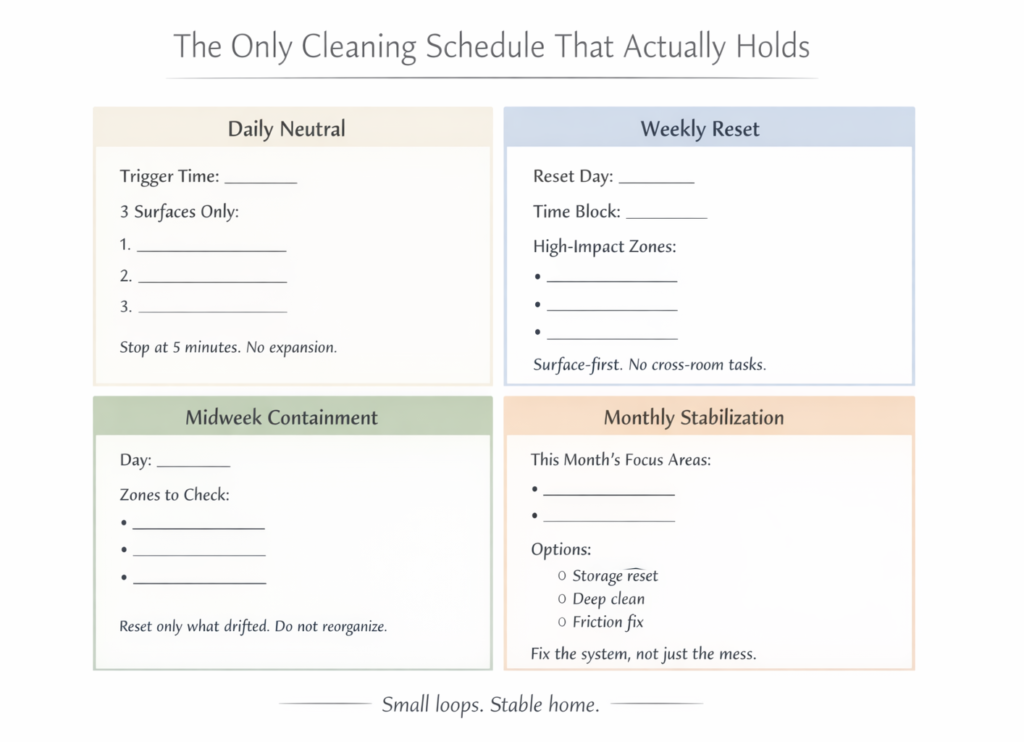
A Simple Template You Can Start Using Today
A functional schedule fits on a single page.
Daily includes three surface resets anchored to a fixed time.
Weekly includes a structured ninety-minute reset focused on visible areas.
Monthly includes one or two focused improvements.
If the structure feels heavy, it will not hold. Simplicity is the strength of the system.
How to Keep This System Working Long-Term
A system is only useful if it survives imperfect weeks.
The Bad-Week Rule
If a full reset is not possible, complete only the highest-impact zones.
The Low-Energy Rule
Reduce scope instead of skipping entirely. Consistency matters more than completeness.
When to Rebuild the System
Only revisit the structure when your living situation or routines change significantly.
Conclusion
A clean and organized home is not the result of effort alone. It is the result of structure applied consistently.
Small daily resets prevent visible chaos. Weekly resets restore balance. Monthly adjustments keep the system functional. Together, they create a loop that holds even when life becomes uneven.
If you want a simple starting point, begin with the 90-minute Sunday reset. It restores control quickly.
If you want the full system that prevents drift altogether, the 7-Day Home Reset Framework builds the structure behind it.
The goal is not perfection. The goal is to make order the default state your home returns to.