
A couples chore chart feels like the responsible thing to do.
You sit down together. You list out the tasks. You divide them evenly. You feel aligned for a moment. It looks fair. It looks organized. It looks like progress.
And for a few weeks, it often works.
Then something subtle happens. One person still reminds. One person still notices. One person still initiates. The chart remains on the wall, but the mental load quietly settles back into familiar patterns.
The issue is not effort. It is not laziness. And it is not a lack of goodwill.
It is structural.
Table of Contents
What a Couples Chore Chart Actually Divides
A typical couples chore chart divides execution.
It answers questions like:
Who washes the dishes.
Who takes out the trash.
Who does the laundry.
Who handles groceries.
On paper, this creates visible equality. Each partner has assigned tasks. Responsibilities look balanced. The system appears clear.
But chore charts are designed to track actions, not ownership.
They divide what gets done.
They do not clarify who initiates it.
That distinction is where most imbalance begins.
Where Most Couples Chore Charts Break Down
A chore chart often fails in three predictable ways.
1. Initiation Remains Undefined
Two people may agree that groceries are shared. One cooks. The other shops. The chart reflects a neat division.
But who notices when groceries are running low?
Who decides when it is time to shop?
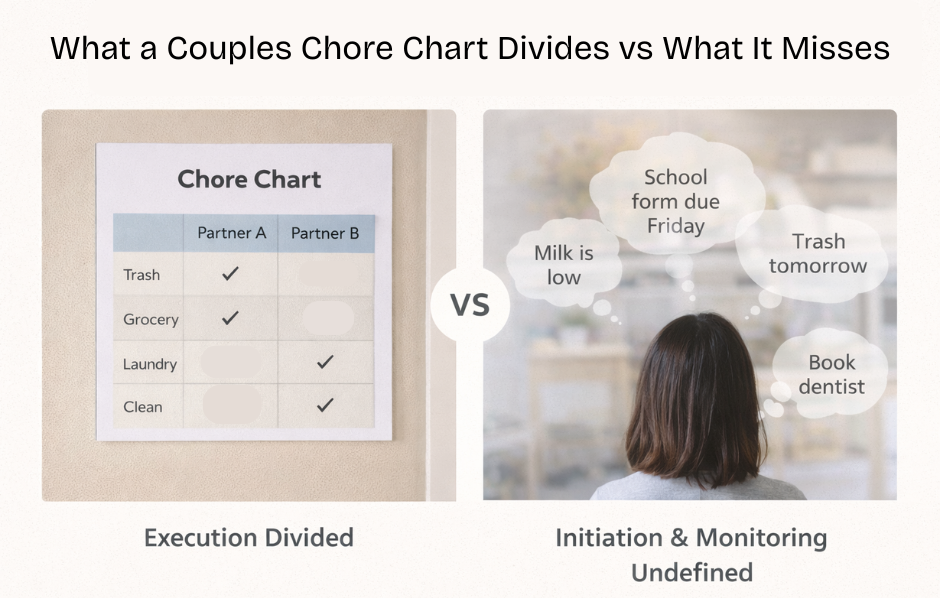
If one partner consistently carries that trigger, they carry more mental load even if the physical task is shared.
A couples chore chart assigns execution. It rarely assigns initiation.
Without initiation clarity, tasks float until someone notices. Over time, the same person usually notices first.
That pattern hardens quietly.
2. Monitoring Stays Invisible
Chore charts capture visible work. They do not capture monitoring.
Monitoring includes:
Keeping track of household supplies.
Watching for school emails.
Remembering birthdays and appointments.
Checking when bills are due.
Tracking maintenance needs.
Monitoring does not look like a task, so it rarely appears on a couples chore chart. But monitoring requires attention, and attention consumes energy.
When one partner becomes the default monitor, they carry an invisible dashboard in their head. The chart on the wall does not reflect that layer.
This is why many couples say, “We split everything, but I still feel like I’m managing the house.”
They are describing monitoring load.
3. Frequency and Friction Are Ignored
A chore chart typically divides tasks evenly by count.
But tasks do not weigh the same.
Some happen daily. Some weekly. Some monthly.
Some are quick but draining.
Some are long but routine.
If one partner takes three daily tasks and the other takes two monthly tasks, the chart may look balanced. The lived experience will not.
Without accounting for frequency and cognitive friction, visible equality can hide structural imbalance.
This is not a flaw in your effort. It is a limitation of the tool.
Why Fairness Conversations Don’t Fully Solve It
When imbalance resurfaces, most couples respond with another conversation.
“We need to rebalance.”
“Let’s adjust the chart.”
“Can you take this one instead?”
These conversations are reasonable. But if the structure underneath remains the same, the imbalance returns.
If initiation is still undefined, the same person keeps noticing.
If monitoring is still invisible, the same person keeps tracking.
If load is not calibrated, one person absorbs more strain.
The chore chart changes. The pattern does not.
When conversations become reactive rather than structural, renegotiation replaces stability.
What Works Instead of a Basic Couples Chore Chart
If a chore chart divides execution, what needs to be installed instead is ownership clarity.
That shift changes everything.
1. Make Recurring Work Fully Visible
Before dividing anything, both partners need to see the full structure of recurring responsibilities, not just visible chores.
That includes:
Planning tasks.
Monitoring tasks.
Coordination tasks.
Administrative tasks.
When everything that happens in a typical month is mapped clearly, conversations move away from impressions and toward shared reality.
Visibility reduces defensiveness because the discussion is no longer about memory. It is about structure.
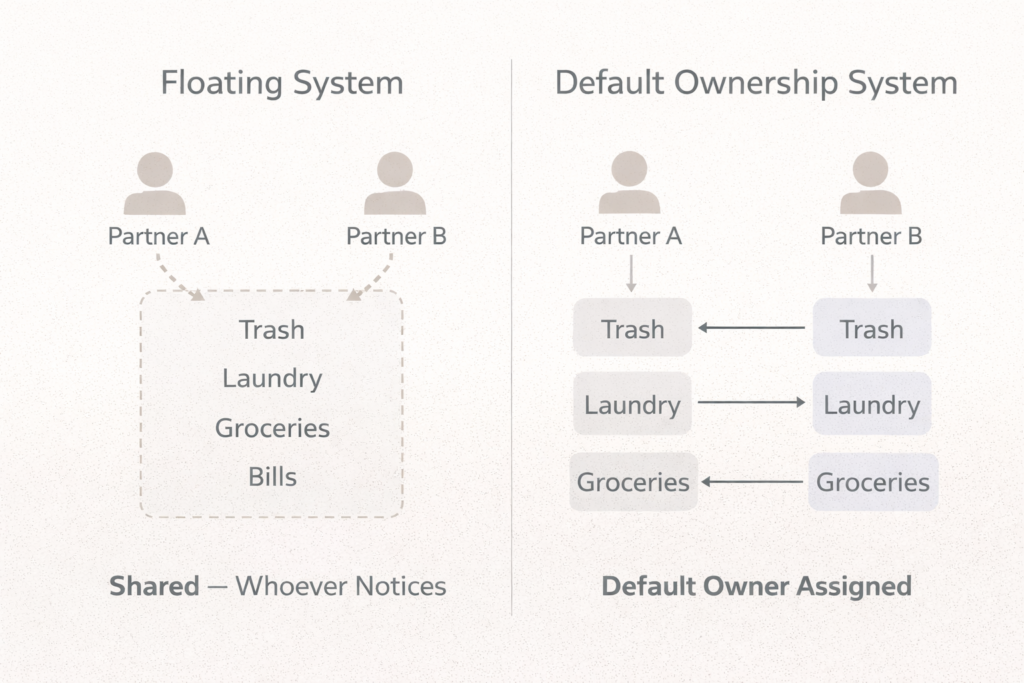
2. Assign Default Ownership, Not Just Tasks
Instead of asking, “Who does this?” ask a different question:
Who initiates this?
Every recurring responsibility needs one default owner. Not as a burden. Not as a rigid role. Simply as a primary trigger.
Default ownership means:
This person notices when it is due.
This person initiates it.
This person tracks recurrence.
Execution can still be shared. Help can still be offered. But initiation is no longer ambiguous.
When default ownership is explicit, tasks stop floating. The mental layer begins to distribute more evenly because initiation is no longer assumed.
If you want a deeper breakdown of how initiation and monitoring create mental load, our guide on mental load in relationships explains the structural layers in detail.
3. Calibrate Real Load, Not Just Task Count
Instead of counting tasks, evaluate total load.
Look at:
How often a task occurs.
How much time it requires.
How much coordination or emotional bandwidth it demands.
A five-minute daily task may carry more cumulative load than a one-hour monthly task.
When couples evaluate structural load rather than visible equality, adjustments become grounded. You are no longer negotiating feelings. You are adjusting weight.
The goal is not perfect symmetry. It is sustainable balance.
4. Install a Weekly Alignment Rhythm
Even the clearest system drifts without maintenance.
Schedules change. Work stress increases. Children’s needs shift. Without a predictable review rhythm, small imbalances accumulate quietly.
Instead of renegotiating midweek under stress, install a short weekly alignment check.
Fifteen to twenty minutes.
Review what felt heavy.
Adjust one or two responsibilities if needed.
Reconfirm ownership.
When review has a scheduled place, conversations calm down. Structure absorbs friction before it compounds.
If Your Couples Chore Chart Keeps Failing
If you have tried a couples chore chart and it helped briefly but did not hold, that does not mean you failed.
It likely means the tool was incomplete.
Chore charts divide visible work. They do not redesign invisible structure.
If you find that one partner still carries more remembering, more initiating, or more monitoring, the issue is not effort. It is infrastructure.
Installing clear ownership, calibrated load, and a defined weekly rhythm addresses the structural layer beneath chores.
Responsibility Architecture™ was built specifically for this level of clarity. Not as a replacement for effort, but as a replacement for ambiguity.
A More Stable Alternative to a Couples Chore Chart
When responsibility is visible, ownership is explicit, and load is calibrated realistically, something subtle shifts.
Reminders decrease.
Repeated conversations shorten.
Resentment loses fuel.
The home does not feel perfectly optimized. It feels predictable.
A couples chore chart can be a starting point. But if you want lasting stability, you need more than a list.
You need structure.
And structure, once installed properly, carries far more weight than any chart on the wall.