
Table of Contents
How to divide household chores fairly sounds simple. In reality, it’s one of the most common sources of low-level tension for busy couples.
Most working couples are not arguing about dishes or laundry. They are reacting to something deeper. One person feels like they are noticing everything. The other feels like they are helping, but still being corrected.
The issue is rarely effort. It is usually unclear ownership.
When household chores for working couples are managed informally, small misunderstandings repeat. Over time, those repetitions build frustration.
Fairness does not come from splitting tasks evenly. It comes from creating shared structure.
Why Chores Feel Uneven Even When Both Partners Are Trying
Most couples are not avoiding responsibility. They are operating without clarity.
The Invisible “Noticer” Role
In many homes, one person becomes the default noticer.
They see when the trash is almost full.
They remember that laundry needs switching.
They track when groceries are running low.
The other partner may be fully willing to help. But if tasks are triggered by reminders instead of ownership, the mental load at home concentrates in one place.
Over time, that imbalance feels personal, even if it was never intentional.
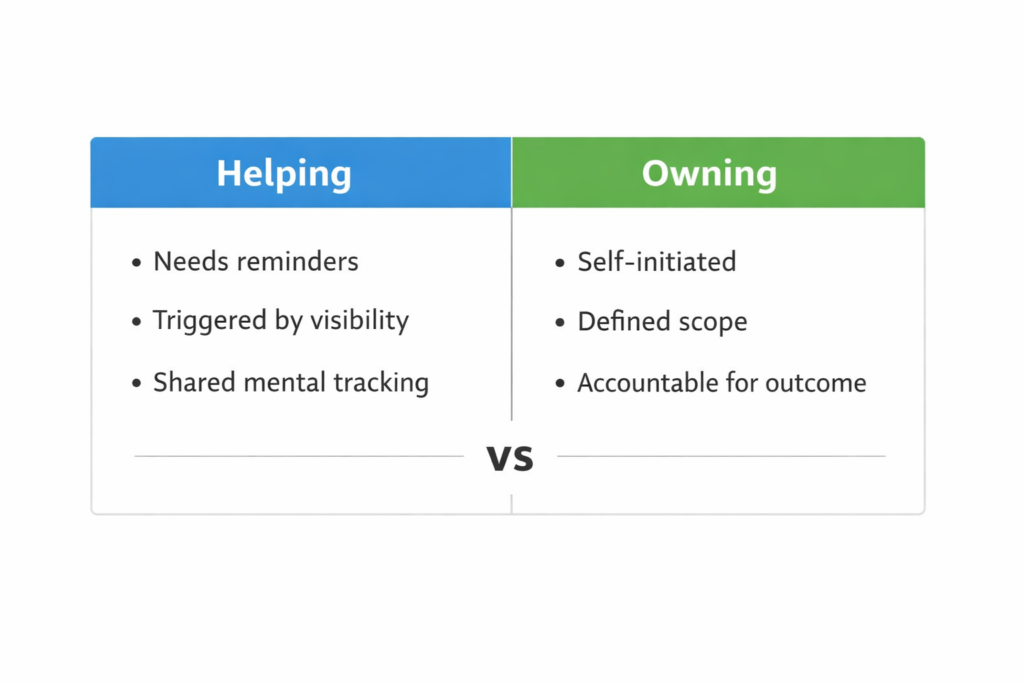
Helping Is Not the Same as Owning
There is an important difference between helping and owning.
Helping means stepping in when asked.
Owning means anticipating, planning, and completing a task without prompting.
When household chores for working couples rely on help instead of ownership, the person tracking everything continues to carry the cognitive burden.
The frustration is not about the physical task. It is about the constant oversight.
Why Even “Equal” Splits Can Feel Unfair
Some couples attempt a 50/50 split.
But equal is not always clear.
Does taking out the trash once a week equal managing meals daily?
Does vacuuming equal remembering school schedules and restocking supplies?
Fairness depends on clarity, not just distribution.
Without defined ownership and scope, dividing household chores fairly becomes subjective. Subjectivity creates tension.
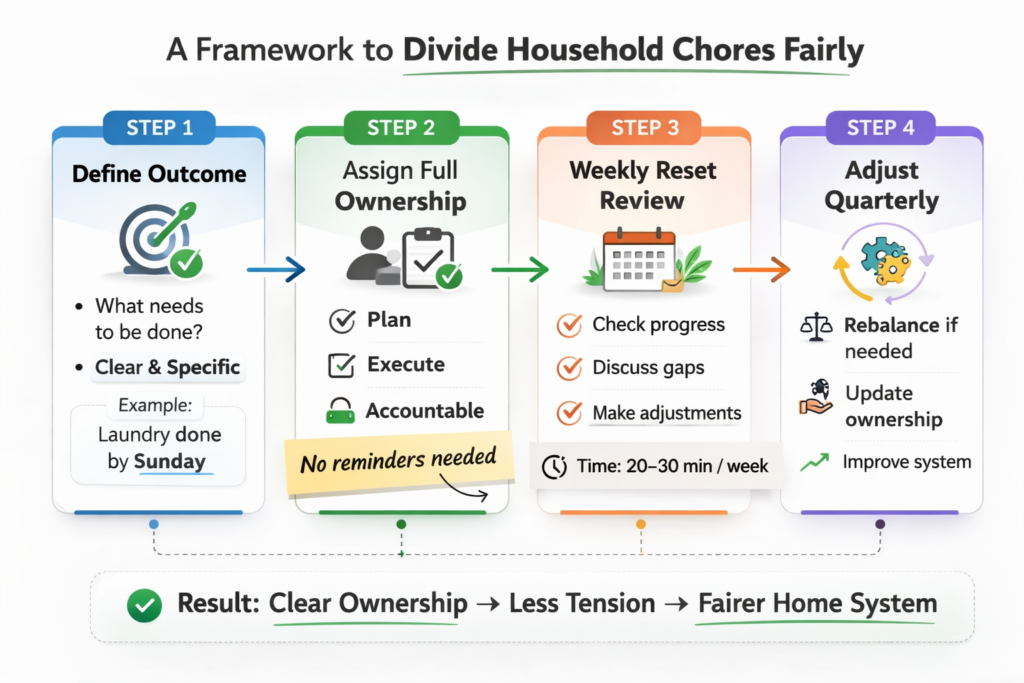
A Simple Framework to Divide Household Chores Fairly
Fairness improves when structure improves.
Instead of negotiating tasks week after week, create clarity once and let the system do the work.
Here is a simple approach that works well for busy couples.
Step 1: List Outcomes, Not Tasks
Most couples divide chores by listing activities.
Laundry. Dishes. Trash. Groceries.
That often leads to partial ownership.
A better starting point is outcomes.
For example:
“Laundry is fully washed, dried, folded, and put away by Sunday evening.”
“The kitchen returns to baseline each night.”
“Groceries are stocked for the week by Monday morning.”
When you define the outcome clearly, you reduce ambiguity about what “done” means.
Clarity lowers friction immediately.
Step 2: Assign Full Ownership
Once outcomes are clear, assign full ownership to one person.
Full ownership includes:
Planning the timing
Remembering the task
Executing it
Correcting it if something slips
This does not mean the other partner cannot help. It means the mental load at home does not remain shared in a vague way.
Ownership reduces negotiation.
Step 3: Define a Weekly Reset Point
Even with ownership, life will disrupt routines.
That is why every home needs a defined weekly reset routine.
Choose a specific time each week to review:
What slipped
What needs adjusting
Whether ownership still feels balanced
This reset prevents drift. Without it, small gaps accumulate quietly.
Step 4: Revisit Quarterly, Not Daily
Fairness should not be renegotiated every week.
After implementing a home maintenance system, give it time to stabilize.
Revisit structure every few months, not every few days. Constant renegotiation recreates the very tension you were trying to remove.
Structure works best when it is steady.
How This Connects to Structural Drift
When household chores feel uneven, it is rarely about one partner caring more than the other. It is usually a sign of structural drift.
Drift happens when ownership is informal, outcomes are undefined, and there is no clear weekly reset routine to realign the system. Over time, that drift increases the mental load at home and creates tension that feels personal.
Dividing household chores fairly is not just about balance. It is about design. When ownership is clear and reset points are defined, friction decreases naturally. Conversations become simpler. Expectations become visible.
If you want a deeper understanding of how structural drift builds and why keeping a home organized feels harder than it should, you can read the full breakdown here.
Start Small, Then Stabilize
If this feels overwhelming right now, do not redesign your entire home system tonight.
Start by clarifying one outcome. Assign one area full ownership. Run one weekly reset conversation.
If you need a structured way to regain control quickly, the 90-Minute Sunday Reset gives you a focused starting point. It helps you re-establish baseline clarity without turning the whole weekend into a negotiation.
From there, you can build a more deliberate structure if you choose.
Fairness does not come from constant discussion. It comes from shared architecture.
If you decide you want to go beyond dividing chores and formalize how your entire home operates week to week, the 7-Day Home Reset Framework builds that structure more deliberately. It helps you define ownership, clarify outcomes, and establish a repeatable weekly reset rhythm so drift does not quietly return.