
Table of Contents
If you’re part of a busy couple and home organization for busy couples feels harder than it should, you’re not alone. We’ve seen this up close, and we’ve lived it too.
You reset on the weekend. You promise to stay on top of things. For a few days, it works. Then by midweek, the laundry piles up, the kitchen slips, and that quiet feeling of being behind creeps back in.
It’s frustrating because you’re both responsible adults – you work hard, and you care about your home.
But home organization for working couples isn’t just about effort. When there’s no shared rhythm or structure, small gaps turn into recurring friction. And over time, that friction drains more energy than it should.
Why Home Organization for Busy Couples Feels Emotionally Exhausting
It doesn’t usually feel like a crisis. It feels like a steady drain.
The Low-Grade Stress That Never Fully Leaves
When a home lacks structure, nothing feels finished. Even after cleaning, there’s a sense that something else is waiting. A drawer needs sorting. The laundry isn’t fully done. The floor will need attention again tomorrow.
This constant awareness creates a low-level tension. You may not talk about it directly, but you both feel it. The house sits in the background of your day as an unfinished task.
Over time, that background noise turns into fatigue.
Repeated Conversations, Same Topics
Many busy couples have the same discussions again and again.
Who was supposed to handle the groceries?
Why does the kitchen reset feel uneven?
Why does one person feel more responsible for noticing what’s out of place?
These aren’t dramatic arguments. They’re small, repeated negotiations. But repetition builds weight. When home maintenance depends on reminders and memory instead of a system, emotional energy gets spent quickly.
The Feeling of Always Being Behind
You clear one surface and notice another. You finish one task and remember two more.
Without a weekly home reset routine or defined structure, there is no clear “we’re back on track” moment. The line between done and not done stays blurry.
That blurriness is what makes keeping a home organized feel harder than it should. It’s not the physical effort alone. It’s the mental load at home that never fully switches off.
The Hidden Cognitive Load Behind Home Organization
The exhaustion isn’t only emotional. It’s mental.
Too Many Small Decisions, Every Day
Keeping a home organized requires dozens of tiny decisions.
Is the laundry full enough to run?
Should the dishwasher go on tonight or tomorrow morning?
Who’s handling dinner cleanup?
What needs restocking before the week starts?
Individually, none of these decisions are difficult. Together, they create cognitive overload. When there is no clear home maintenance system, every task requires attention, memory, and follow-up.
Busy couples already carry heavy mental demands from work and family. Adding constant micro-decisions at home stretches that capacity thin.
When Everything Is Negotiable
In many households, tasks are not clearly assigned. They are assumed, implied, or discussed in the moment.
That means each chore becomes negotiable.
Negotiation sounds reasonable; in practice, however, it increases friction. Instead of a predictable rhythm, there is uncertainty, and instead of clarity, there is interpretation.
Over time, this affects how couples divide chores fairly. One person often becomes the default “noticer,” carrying more of the mental load at home without intending to.
The issue is not willingness, but the absence of structure.
Why Clutter Keeps Coming Back
Without defined ownership and a reset rhythm, maintenance becomes reactive.
You tidy when things look messy.
You organize when it feels urgent.
You reset when you have spare time.
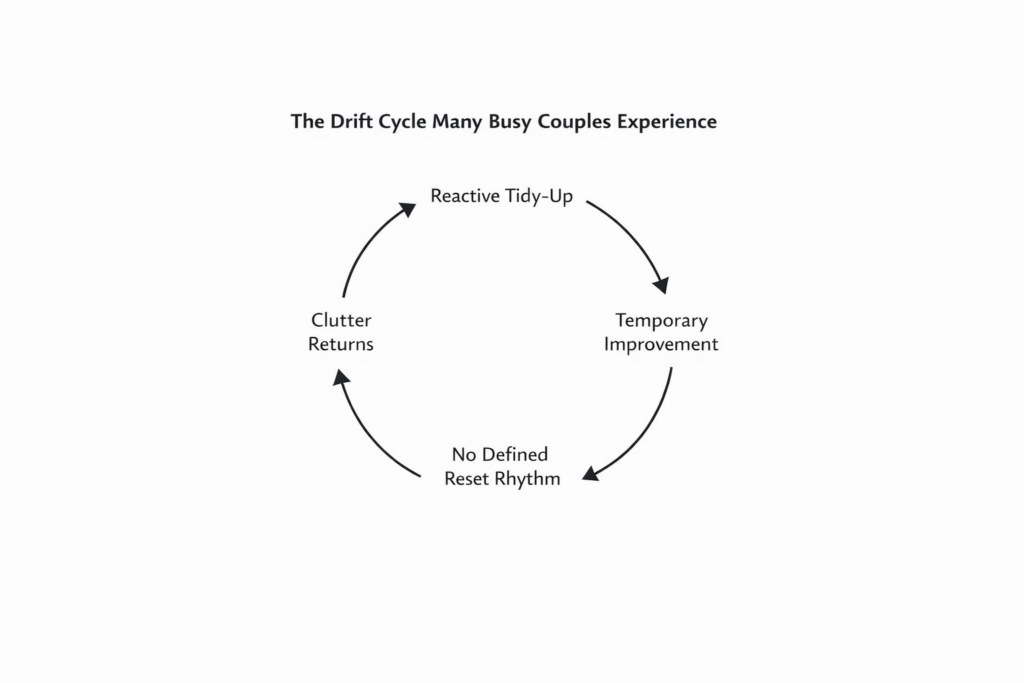
That pattern creates cycles. The house improves briefly, then slides back. Clutter returns because nothing changed underneath. There is still no defined weekly home reset routine holding everything in place.
When structure is missing, effort has no anchor.
Structural Drift: The Real Reason Homes Feel Unstable
What many busy couples experience has a name: structural drift.
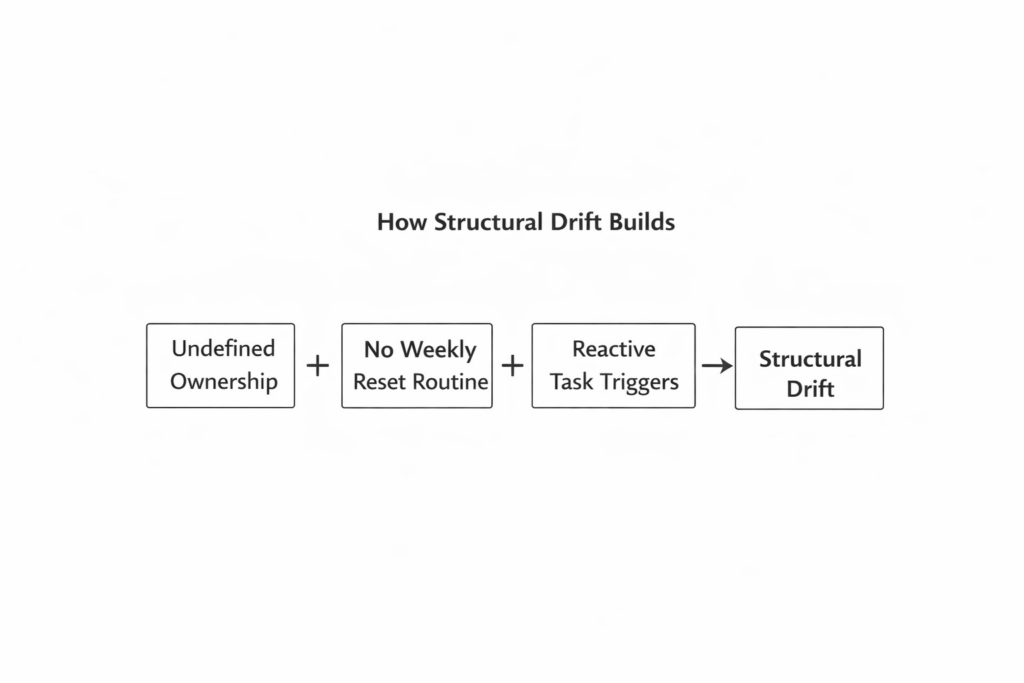
Structural drift happens when a home operates without a defined rhythm, clear ownership, or a predictable reset point. Nothing breaks at once. Instead, small gaps accumulate quietly. Home organization for busy couples becomes difficult not because of effort, but because there is no shared reset rhythm.
How Structural Drift Begins
It usually starts subtly.
A skipped reset one weekend.
An unclear expectation about who handles what.
A busy week that pushes routines aside.
Because there is no built-in correction point, the system does not pull itself back into alignment. The home relies on memory and goodwill instead of structure.
That works for a while. Then the drift compounds.
The Difference Between a System and Good Intentions
Most couples operate on good intentions. If something needs doing, someone will eventually notice. If things feel messy, you will try to fix them.
But good intentions are not the same as a home maintenance system.
A system defines:
- When tasks happen
- Who owns them
- What “done” looks like
- How the home resets when a week goes off track
Without those definitions, stability depends on energy levels and availability. And energy is never consistent.
Why Structural Drift Feels Personal
When drift builds, it often feels like a personal failure.
You might think you are disorganized.
You might assume your partner is less attentive.
You might question why keeping a home organized feels harder for you than for others.
But structural drift is not a character flaw. It is a design gap.
When structure is unclear, friction increases. When friction increases, tension follows. The solution is not more effort. It is clearer architecture.
Why Cleaning More Doesn’t Fix Structural Drift
When a home feels unstable, the natural response is to clean harder.
It feels productive. It creates visible progress. It offers a sense of relief.
But relief and stability are not the same thing.
Event-Based Effort vs Rhythm-Based Stability
Cleaning is usually event-based.
You clean when things look messy.
You declutter when surfaces feel crowded.
You reorganize when frustration peaks.
These efforts can make a home look better quickly. They do not change how the home operates week to week.
Stability comes from rhythm. A rhythm defines when resets happen, how tasks cycle, and how the home returns to baseline after a busy stretch.
Without rhythm, every week starts from scratch.
The Motivation Trap
Many busy couples rely on motivation.
After a long workweek, you decide to “get on top of everything” this weekend. You make a strong start. You put in hours. You feel hopeful.
Then work intensifies again. A late meeting disrupts dinner. One evening reset is skipped. Momentum fades.
When keeping a home organized depends on feeling energized, it will always fluctuate. Real life is uneven. A home maintenance system needs to absorb that unevenness, not depend on perfect consistency.
Why Clutter Keeps Reappearing
Clutter returns because nothing structural changed.
Ownership is still informal.
The weekly home reset routine is still undefined.
Tasks are still triggered by visibility instead of schedule.
So the house improves briefly and then drifts again.
The issue is not that you did not try hard enough. The issue is that the architecture underneath remained the same.
If You Need Immediate Relief
If your home feels heavy right now, you do not need to overhaul everything.
You need a clear starting point.
When structural drift builds up, the hardest part is not cleaning. It is knowing where to begin without turning the entire weekend into a recovery project.
A Focused Reset You Can Complete in One Sitting
That is why we created the 90-Minute Sunday Reset.
It is a simple, structured session designed to help busy couples regain control in one focused block of time. It narrows attention to the areas that restore baseline stability instead of trying to fix the entire house.
You do not need special tools. You do not need a free day. You need ninety minutes and a shared commitment to follow the sequence.
The goal is not perfection. It is clarity.
What This Reset Actually Does
The 90-Minute Sunday Reset helps you:
- Re-establish a visible baseline
- Clear the most disruptive friction points
- Align on what the coming week requires
- Reduce the mental load at home immediately
It is not a full home maintenance system. It is a stabilizer.
For many couples, that single session is enough to shift the tone of the week.
If You Want to Go Deeper
The 90-Minute Sunday Reset is a starting point.
For many couples, that single session creates immediate clarity. It helps you see what was unclear and where the friction was building. It gives you a visible baseline to work from.
Sometimes that shift alone changes the tone of the week.
When You’re Ready to Formalize the Structure
As you run the reset a few times, you may notice patterns.
Where ownership feels fuzzy.
Where tasks repeat.
Where drift begins.
If you decide you want a more defined structure, the 7-Day Home Reset Framework builds that foundation more deliberately.
Over one focused week, it helps you:
- Clarify who owns what
- Define what “done” actually means
- Restore order progressively instead of all at once
- Establish a repeatable weekly reset routine
It’s not about doing more. It’s about formalizing what works and removing what doesn’t.
Stability Is Built, Not Hoped For
Keeping a home organized should not feel like a recurring emergency.
When structure is unclear, effort expands. When rhythm is undefined, small gaps become repeated friction. Over time, that friction drains more energy than the tasks themselves.
Most busy couples are not short on responsibility. They are short on architecture.
A defined reset rhythm reduces negotiation. Clear ownership lowers the mental load at home. A simple home maintenance system absorbs uneven weeks without collapsing.
You do not need to work harder.
You need a structure that holds, even when life speeds up.
Start with one focused reset if that is what you need today. Then build the rhythm that prevents drift tomorrow.