
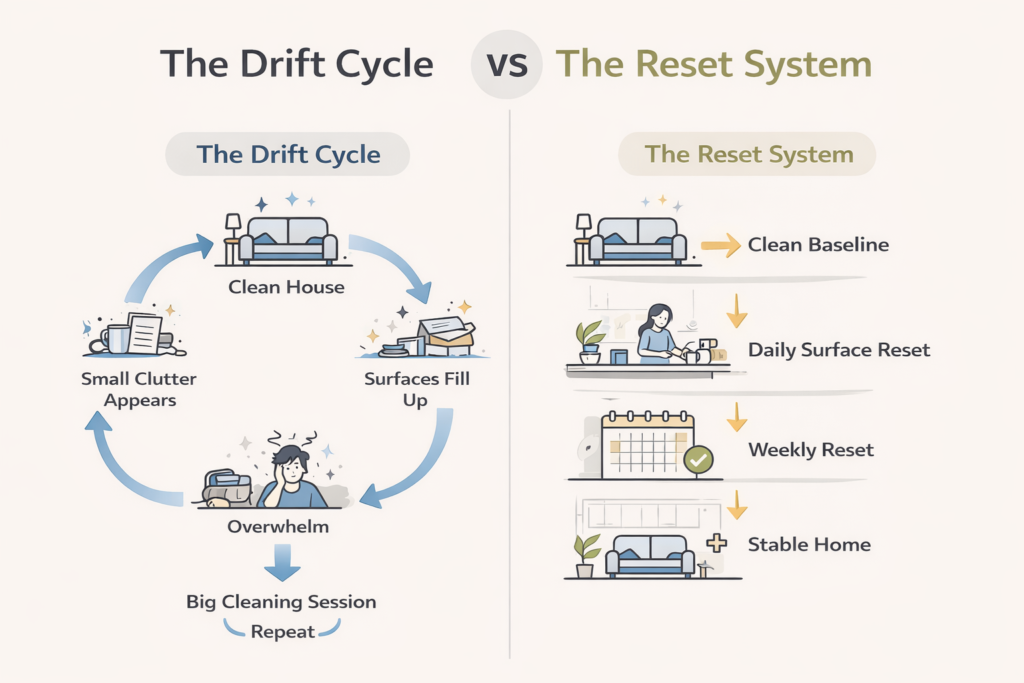
A clean home rarely falls apart in one dramatic moment. It drifts. You put things down “just for now,” surfaces begin to fill, and before you notice, the house feels heavier than it did a few days ago. So you clean. You reset everything. It feels good again. And then, slowly, the same pattern returns.
Most people assume this cycle means they need more discipline or more time. In reality, it points to something else. How to keep house clean and organized is less about effort and more about structure. Once that shift clicks, everything becomes easier to manage.
Table of Contents
Why Keeping Your House Clean Feels So Hard
At first glance, the problem seems simple. If a house gets messy, you clean it. But the experience of most households tells a different story. Cleaning works, but only temporarily. The real issue sits underneath.
Cleaning Is Event-Based, Living Is Continuous
Cleaning happens in bursts. A weekend reset, a quick tidy before guests arrive, a deep clean once in a while. Life, on the other hand, is continuous. Things move, accumulate, and shift every single day. When an occasional activity tries to compete with a constant flow, the result is predictable. The system breaks down between cleanings.
Clutter Builds Gradually, Not Dramatically
No one wakes up to a suddenly chaotic home. It happens slowly. A plate left on the counter. A bag dropped on a chair. Papers placed on the dining table “for later.” Each decision feels small in isolation, which is why it rarely triggers action. But over time, these small decisions stack into visible clutter.
Effort Alone Cannot Compete With Daily Flow
There are days when energy is low, schedules are tight, and attention is elsewhere. Any system that depends entirely on consistent effort starts to fail under real-life conditions. This is why motivation-based cleaning routines rarely last. They assume a level of consistency that most households cannot maintain.
The Real Shift: From Cleaning More to Managing Flow
A clean home is not maintained by working harder. It is maintained by reducing friction in how things move through the home.
Homes Do Not Stay Clean Automatically
Every home has a default direction. Without structure, that direction is toward clutter. Items enter, get used, and then settle wherever it is easiest to leave them. This is not carelessness. It is the natural path of least resistance.
What Actually Needs to Be Managed
Instead of focusing on cleaning tasks, it helps to look at movement. Where do things land when you come home? Where do used items go after a meal? Where do small objects accumulate during the day? These movement patterns determine whether a home stays stable or drifts out of control.
Why Most Advice Misses This
Typical advice focuses on actions: clean more often, tidy daily, stay organized. While useful, these suggestions do not address the underlying structure. Without changing how items flow through the home, cleaning becomes a repeated reaction instead of a stable system.
The Three Elements of a Clean and Organized Home
Most homes do not need dozens of habits or complicated routines. They need a few well-placed structures that hold even when life gets busy.
Surface Control: Where Clutter Shows Up First
Clutter is experienced visually, and most of that visual weight sits on a few key surfaces. The dining table, kitchen counter, entry area, and bedside spaces carry a disproportionate share of the load. When these areas are clear, the home feels under control, even if other parts are not perfect.
Focusing on these surfaces creates immediate stability. Instead of trying to manage everything, attention is directed where it has the highest impact. This approach reduces overwhelm and creates a visible baseline that is easier to maintain.
Containment Rules: Where Things Go Without Thinking
Organization does not require complex storage systems. It requires clarity. Every frequently used item benefits from having a predictable place. Keys go in one spot. Bags land in one area. Papers have a defined holding zone.
The goal is to remove decision-making from everyday actions. When there is no question about where something belongs, it gets placed correctly without effort. Over time, this reduces the small decisions that contribute to clutter.
Reset Rhythm: How You Prevent Drift
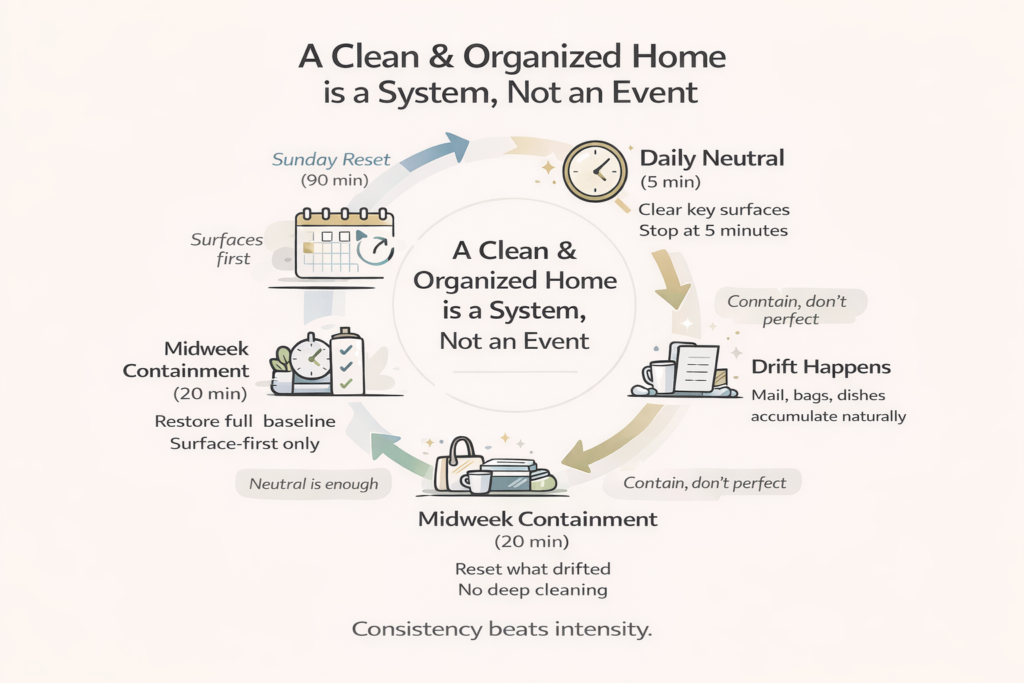
Even with good structure, some level of drift is inevitable. The difference lies in how quickly it is corrected. A short daily reset keeps surfaces from accumulating too much. A weekly reset brings everything back to baseline.
This rhythm does not need to be rigid. What matters is consistency over intensity. A few minutes each day and a structured weekly reset create a system that absorbs small disruptions without collapsing.
Why Most Cleaning Routines Do Not Work Long-Term
Many routines fail not because they are wrong, but because they are mismatched with how people actually live.
Too Many Tasks, Too Little Consistency
Long checklists look productive, but they are difficult to sustain. When routines become too detailed, they are more likely to be skipped on busy days. Once skipped, it becomes harder to restart, and the system slowly unravels.
Not Designed for Real Life
Real households deal with uneven schedules, unexpected interruptions, and fluctuating energy levels. A routine that works only under ideal conditions will fail under normal ones. Systems need to be flexible enough to hold during imperfect weeks.
No Recovery System
Many routines assume perfect consistency. When that breaks, there is no clear way to recover. One missed week leads to visible clutter, which increases resistance to restarting. Over time, this creates the familiar cycle of cleaning, falling behind, and starting over again.
A Simple System That Keeps Your Home Organized
Instead of trying to fix everything at once, a more effective approach builds from a stable foundation and adds structure gradually.
Start With a Clean Baseline
Before maintenance can work, the home needs a reset point. This does not require perfection. It requires reducing visible clutter enough to create a clear starting position. If you have already worked through decluttering, this step is familiar. If not, beginning with a focused reset makes everything that follows easier.
Control Surfaces, Not Everything
Trying to organize every drawer and shelf at once creates unnecessary pressure. Focusing on key surfaces simplifies the process. Keeping these areas clear creates a sense of order that carries through the rest of the home. It also makes daily resets faster and more manageable.
Install a Weekly Reset
A structured weekly reset acts as the backbone of the system. It brings the home back to baseline in a predictable way. Over time, this reduces the need for large, exhausting cleaning sessions. Instead of reacting to clutter, the system prevents it from building up.
Share Responsibility Where Needed
In shared homes, structure matters even more. When responsibilities are unclear, tasks tend to fall unevenly. This creates friction and makes consistency harder to maintain. Defining who handles what, even at a simple level, reduces this pressure and makes the system more reliable.
What This Looks Like in Real Life
A system only works if it fits into daily life without adding stress.
A Typical Week
On most weekdays, the system runs quietly in the background. A few minutes in the evening clears key surfaces and resets the space. The effort is small, but it prevents accumulation.
The weekly reset acts as a checkpoint. It brings everything back into alignment, clears any drift that has built up, and prepares the home for the next cycle. This rhythm creates predictability without rigidity.
When a Week Goes Off Track
There will be weeks when routines slip. Travel, work pressure, or unexpected events can disrupt even the best systems. The difference lies in recovery. Because the structure is simple, it is easier to return to it. The system absorbs the disruption instead of collapsing under it.
Keeping Your House Clean Does Not Have to Feel Hard
A clean home does not require constant effort. It requires a structure that works even when effort is limited.
You do not need a perfect system that covers every detail. You need a stable baseline that holds most of the time. You do not need more time in your day. You need fewer decisions and clearer defaults. And you do not need to rely on motivation. You need a system that continues to work when motivation is low.
If you want a simple way to put this into practice, the 7-Day Home Reset Framework translates these ideas into a clear weekly structure you can follow without overthinking. If managing responsibilities across people feels like the bigger challenge, Responsibility Architecture™ helps define ownership so the system does not depend on one person.
The goal is not to keep your home perfectly clean at all times. The goal is to create a home that returns to order easily, even after a busy week. Once that happens, the cycle of constant cleaning starts to fade, and the home begins to feel stable again.