
You ask yourself, “I want to declutter my house,” and it may sound simple until you actually try to start. You look around, see things everywhere, and your mind does the same. Every room feels urgent. Every surface feels like a project. You tell yourself you’ll begin, but you don’t know where. So nothing moves.
If this feels familiar, the issue isn’t effort. It’s structure. Most decluttering advice assumes you already have clarity and energy. This article works from a different place. It starts where most people actually are: tired, unsure, and already behind.
Table of Contents
Why Decluttering Feels So Hard to Start
At first glance, clutter looks like a physical problem. In reality, it behaves more like a decision problem.
Too many decisions at once
When everything is visible, everything feels important. Your brain tries to prioritize, but nothing stands out clearly. That creates friction before you even begin.
No clear starting point
Advice often says “start anywhere,” but that’s not helpful when every area looks equally messy. Without a defined entry point, the task expands in your head.
Everything feels connected
You pick up one item, it belongs in another room. You carry it there, notice something else, and now you’re doing three things at once. Progress dissolves.
The pressure to do it properly
There’s a quiet expectation that you should “declutter well.” Sort things. Organize properly. Make it last. That expectation slows you down before you even begin.
When all of this stacks together, starting feels heavier than the task itself.
Why Most Decluttering Advice Doesn’t Work in Real Life
If you’ve tried decluttering before and felt stuck, it’s not because you failed to follow instructions. It’s because the instructions weren’t built for real-life conditions.
Room-by-room creates invisible overwhelm
“Start with the kitchen” sounds logical. But a kitchen is not one task. It’s dozens of micro-decisions. Drawers, counters, cabinets, appliances. You enter with good intent and leave halfway through.
Big checklists create pressure
Long lists look productive on paper. In practice, they remind you how much isn’t done. That drains motivation instead of building it.
Sorting systems slow you down
Keep, donate, discard sounds neat. But each item becomes a decision point. The more decisions you face, the more likely you are to stop.
Perfection delays progress
You don’t want to just clear a surface. You want to fix it properly. That instinct is understandable, but it turns a small task into a large one.
Most advice is built for ideal conditions. Decluttering rarely happens in ideal conditions.
A Simpler Way to Declutter Your House
Instead of trying to manage everything, you reduce the scope of the task. You shift from “clean the house” to “restore control in one place.”
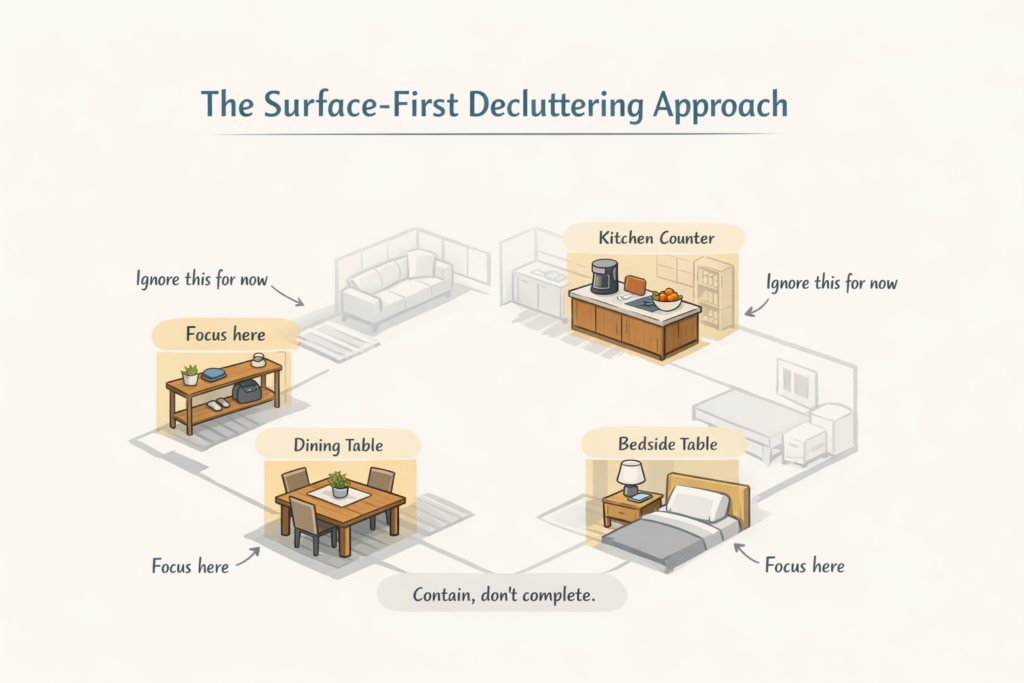
The Surface-First Rule
Start with what you can see.
- Tables
- Counters
- Chairs
- Entry surfaces
Ignore drawers. Ignore storage. Visible surfaces carry most of the mental weight. Clearing them creates immediate relief.
The No-Spiral Rule
If something belongs in another room, place it there and return immediately.
No side tasks. No “since I’m here” moments. This rule protects your focus. Without it, a five-minute reset turns into an hour of scattered effort.
Containment Beats Completion
You don’t need to finish everything. You need to contain the mess.
- Laundry in one basket
- Papers in one stack
- Misc items grouped
Containment reduces chaos quickly. Completion can come later.
These three ideas change how the task feels. You move from “fix everything” to “reduce visible load.”
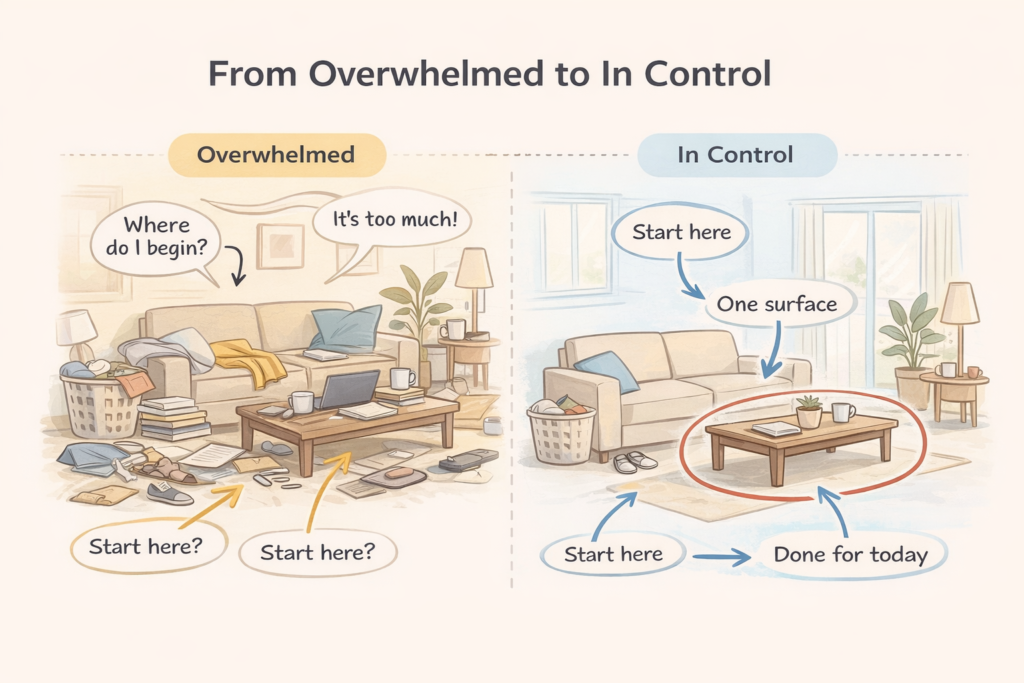
If You Feel Stuck, Start Here (5-Minute Reset)
When motivation is low, the starting point must be obvious and small.
Step 1: Choose one surface
Not a room. Not an area. One surface.
Example:
- dining table
- kitchen counter section
- bedside table
Step 2: Clear it completely
Move everything off. Put items where they belong or group them nearby. Don’t organize. Don’t sort deeply.
Step 3: Stop
This matters.
You’re not building momentum through exhaustion. You’re building trust that starting is manageable.
A single clear surface changes how the room feels. That shift is enough for one session.
If starting still feels unclear, use a simple guided version instead.
The 90-Minute Sunday Reset walks you through exactly what to do, step by step, without overthinking. It focuses only on visible surfaces and high-impact areas, so you see results quickly without getting pulled into endless cleaning.
You can download it here and try it this week:
A Realistic Decluttering Checklist (That Won’t Overwhelm You)
Instead of a long checklist, you use a rhythm.
Daily: One surface reset
Pick one visible surface and clear it. That’s it.
Weekly: Key zone reset
Identify 2–3 high-impact areas:
- dining table
- kitchen counter
- entry drop zone
Restore them to neutral. Not perfect. Just clear.
Ignore the rest
This is the hard part. You will see other things that need attention. Let them wait.
A controlled system works better than an ambitious one you can’t sustain.
How to Declutter Your House Fast (Without Burning Out)
Speed doesn’t come from doing more. It comes from removing friction.
Use short, defined blocks
Set a 20–30 minute window. Work inside it. Stop when it ends.
This prevents fatigue and keeps the task contained.
Focus on zones, not rooms
Rooms are too large. Zones are manageable.
Examples:
- dining surface
- sink area
- couch area
Stop before you feel drained
Ending early creates a sense of control. That makes it easier to start again later.
Fast decluttering isn’t about rushing. It’s about staying focused and avoiding drift.
Why Decluttering Alone Doesn’t Fix the Problem
You may have noticed this already.
You declutter. The space feels better. A few days later, things start piling up again.
That’s not failure. That’s what happens when there’s no system behind the effort.
Clutter follows patterns
The same places fill up:
- the chair
- the dining table
- the entry
These aren’t random. They are default drop zones.
Without structure, clutter returns
If there’s no defined place for things to land, they land wherever they can.
Decluttering resets the space. It doesn’t prevent the drift.
What Actually Keeps Your House Under Control
To keep things manageable, you need light structure, not more effort.
Daily containment
Small resets prevent buildup. One surface a day keeps things from spreading.
Weekly reset
A short, focused session restores your home to a neutral state. Not spotless. Just under control.
Defined zones
Every high-traffic area needs a simple rule:
- where things go
- when they get cleared
When zones are defined, decisions reduce. When decisions reduce, clutter slows down.
A Different Way to Think About Decluttering
You don’t need to become someone who loves organizing. You don’t need perfect systems or beautifully arranged spaces.
You need a way to:
- start without hesitation
- make visible progress quickly
- keep things from slipping again
Decluttering works when it fits your energy, not when it demands more of it.
If you’ve been stuck, start small. Clear one surface. Let that be enough for today.
But if you’re tired of resetting the same clutter every week, you need something more than occasional decluttering.
You need a simple structure that runs in the background.
The Done By Sunday – 7-Day Home Reset Framework helps you:
- define your key zones
- prevent clutter from building up
- maintain control with small daily and weekly resets
It’s designed for busy households where time and energy are limited.