
When you see a house if cluttered, it rarely begins as a big problem. It builds quietly, in small, forgettable moments. A bag left on a chair. Papers placed on the table “for now.” A kitchen counter that never fully clears. None of it feels serious on its own. But over a few days, sometimes just a week, the space starts to feel heavier.
Most people respond the same way. They clean. They reset everything. For a short while, the home feels back under control. Then, slowly, the same pattern returns.
If that sounds familiar, the issue isn’t effort. It’s something deeper in how the home is running.
Table of Contents
Why Your House Is Cluttered Again So Quickly
A cluttered home often feels like it changed overnight. In reality, it didn’t.
It builds in layers, not events
Clutter rarely arrives all at once. It accumulates in fragments.
A few items on the dining table.
One corner of the kitchen counter that becomes a drop point.
A chair that starts holding clothes instead of people.
Each layer feels temporary. Together, they become the new normal.
Visibility comes late
One reason this feels sudden is because clutter stays below your attention threshold for a while. You notice it only after it crosses a certain point. By then, it looks like a bigger problem than it actually is.
That’s why many homes go from “manageable” to “overwhelming” without a clear moment in between.
The Real Issue: Clutter Is Repeating, Not Random
Most homes are not messy by accident. They follow a pattern.
The cycle most people are stuck in
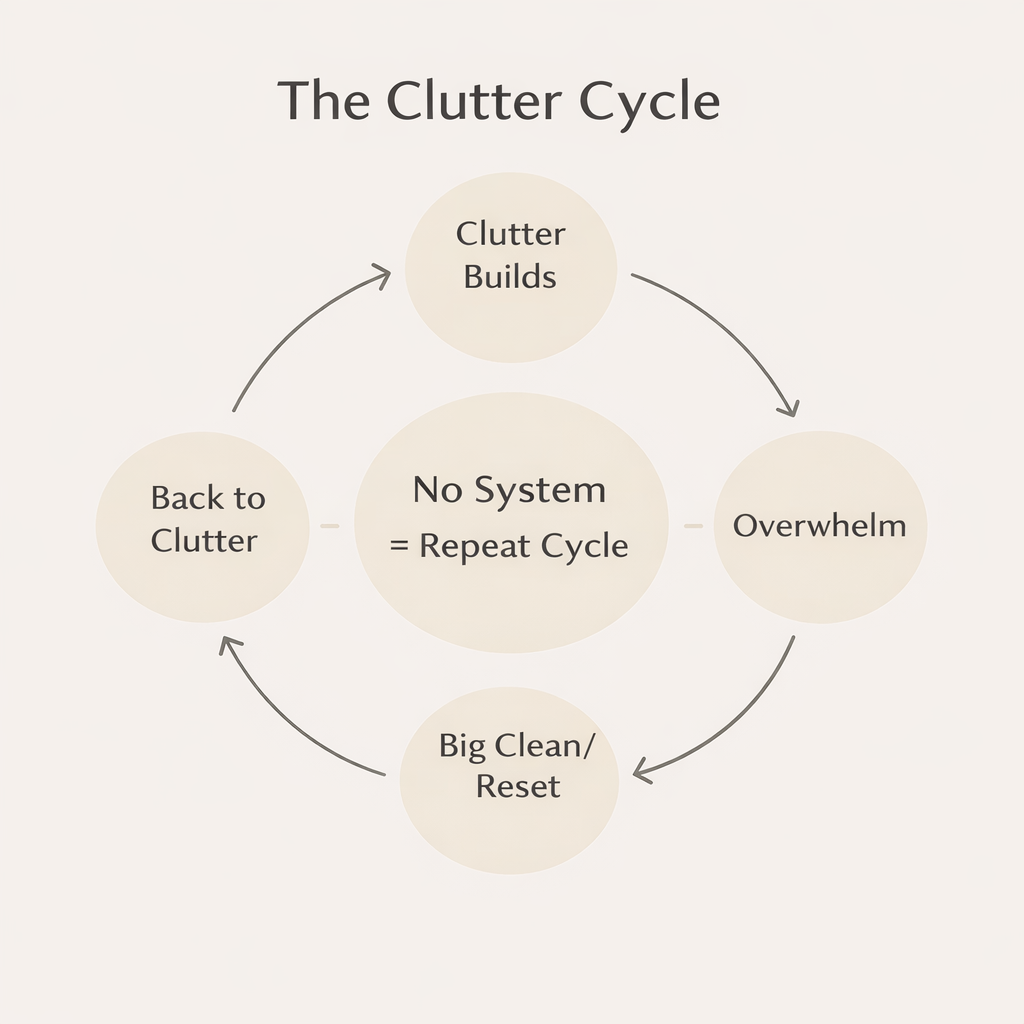
It usually looks like this:
- Things build up during the week
- You clean or declutter
- The house resets
- Life gets busy again
- The same build-up returns
Nothing about this cycle feels unusual. It just keeps repeating.
Why this pattern doesn’t break on its own
There’s no mechanism inside the home that holds things in place after a reset. So every clean slate depends on fresh effort. And effort is always limited.
Over time, the cycle starts feeling like a loop you can’t get out of.
Why Cleaning and Decluttering Don’t Fix It
House is cluttered. Cleaning helps. Decluttering helps. But they don’t solve the part that actually causes the repetition.
Cleaning resets the surface
When you clean, the visible clutter disappears. Surfaces clear. Rooms feel lighter. But the conditions that allowed clutter to build are still there.
Nothing has changed about where things get dropped or how often spaces reset.
Decluttering removes items, not patterns
You can remove a lot from your home and still find it filling up again. That’s because clutter is not only about volume. It’s about flow.
If items don’t have a clear landing place, or if surfaces keep absorbing things without resetting, the same accumulation begins again.
The “big clean” illusion
After a deep clean or a decluttering session, the home often feels solved. That feeling can last a day or two. Sometimes a week.
Then small things return. Not everywhere. Just in a few places. Those places spread.
Before long, you’re back where you started.
How Clutter Actually Builds in Busy Homes
When you look closely, a house is cluttered because it tends to follow very specific patterns.
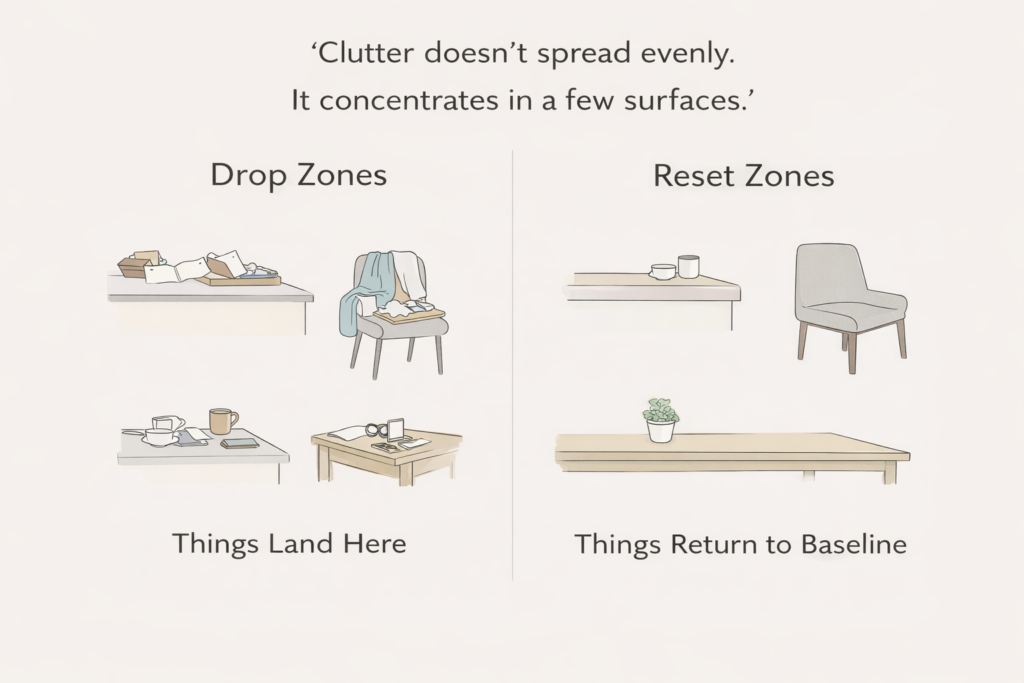
Drop zones form naturally
Every home develops informal zones where things land.
- Kitchen counters
- Dining tables
- Entryway surfaces
- Chairs and corners
These spots are convenient. That’s why they get used. Over time, they become default storage without anyone deciding it.
Resets get skipped
Most homes don’t have a built-in moment when things return to baseline. So resets depend on memory, time, and energy.
On busy days, that reset simply doesn’t happen.
One missed day doesn’t matter. But a few missed resets in a row start to show.
Decisions get postponed
Clutter often contains unresolved decisions.
- Where should this go?
- Do we keep this?
- Should this be moved somewhere else?
Instead of deciding, it gets placed somewhere “for now.” Those “for now” placements accumulate.
The Missing Piece: A System That Holds the Baseline
The difference between homes that stay stable and homes that keep slipping back isn’t effort. It’s structure.
What a functional home system does
A working system doesn’t aim for perfection. It maintains a baseline.
It makes sure that:
- clutter doesn’t accumulate beyond a point
- surfaces return to usable state regularly
- small build-ups don’t become large ones
The idea of a neutral home
Most people think in extremes. Either the home is clean or it’s messy.
In practice, a stable home sits in the middle.
Not spotless. Not chaotic. Just usable, calm, and under control.
That neutral state is what keeps things from slipping too far in either direction.
A Practical Way to Regain Control
You don’t need to start over. You need to interrupt the pattern.
Start with high-impact zones
Not every part of the house needs attention at once.
Focus on the areas where clutter builds fastest:
- kitchen counters
- dining surfaces
- laundry areas
When these stay under control, the whole home feels lighter.
Introduce a weekly reset rhythm
Instead of relying on random cleaning, anchor one predictable reset point in the week.
A simple, consistent reset prevents small build-ups from compounding.
This is where a structured approach like the Done By Sunday Home Reset Framework becomes useful. It gives the home a regular return point without needing daily perfection.
Reduce decision points
Many clutter patterns come from too many small decisions.
When actions are predefined, you don’t have to think every time. You just follow the structure.
That alone reduces a surprising amount of buildup.
Why This Feels Harder for Busy Couples
In dual-income homes, clutter isn’t just about objects. It’s shaped by how time and responsibility are distributed.
Time is fragmented
There may be enough total time across the week, but it rarely exists in one block. That makes it harder to reset things consistently.
Energy is inconsistent
Some days have capacity. Others don’t. Without a system, the home depends on how you feel that day.
Responsibility is unclear
When both partners assume something will get handled, it often doesn’t. Or one person ends up carrying more of it without a clear agreement.
This is where clutter stops being a simple home issue and starts becoming a structural one.
If you’ve felt that organizing your home feels harder than it should, there’s usually a deeper reason behind it. That’s exactly what the broader framework in the main pillar article explores.
When Clutter Turns Into Friction Between Partners
Clutter doesn’t just affect space. It affects how people interact inside that space.
Execution vs planning
One person may be doing visible tasks like cleaning or organizing. The other may not see the planning that goes into keeping things running.
That gap creates imbalance.
Uneven load over time
If responsibility isn’t clearly defined, it tends to drift toward the person who notices the problem first.
Over time, that creates quiet friction.
A clearer ownership structure, like the one outlined in the Responsibility Architecture, helps make this visible and manageable.
What Actually Prevents Clutter From Coming Back
There isn’t a single trick that solves this. But a few shifts make a noticeable difference.
Systems over motivation
Motivation comes and goes. A system stays.
When actions are tied to structure, they happen more consistently.
Consistency over intensity
A small, repeated reset is more effective than a large, occasional one.
It keeps the home within a manageable range.
Ownership over shared ambiguity
When it’s clear who handles what, fewer things fall through.
Clutter often grows in the spaces where responsibility is unclear.
If You Want a Structure That Actually Holds
If this pattern feels familiar, it’s usually not because you’re not trying hard enough. It’s because the home doesn’t yet have a structure that supports the way you live.
The Done By Sunday Home Reset Framework helps establish a weekly baseline so things don’t drift too far. It gives you a repeatable way to bring the home back under control without starting from scratch every time.
Alongside that, the Responsibility Architecture brings clarity to who owns what, especially in shared spaces. It addresses the part of clutter that comes from unclear responsibility rather than lack of effort.
Parting Words
A cluttered home isn’t a sign that something is wrong with you or how you’re trying to manage things. It’s usually a sign that the current setup doesn’t have a way to hold itself together over time.
Once you see how clutter builds and why it repeats, the problem starts to feel less random. And when that happens, it becomes easier to change.
Not by doing more, but by putting the right structure in place so things don’t keep slipping back.