
In many homes, the imbalance does not appear suddenly. It develops quietly over time.
One partner begins noticing things earlier. Groceries running low. School forms due next week. Laundry building up. A kitchen counter that has slowly filled with clutter.
At first, they simply take care of it. It feels easier than discussing it.
Months later, something has shifted. One person feels responsible for nearly everything that keeps the household running. The other helps when asked, but the asking itself becomes exhausting.
This dynamic is incredibly common. It appears in dual-career couples, families with children, and even small households with only two adults.
The surprising part is that the imbalance rarely starts with effort. It usually starts with who notices and initiates tasks first.
Once that pattern forms, one partner gradually becomes the default manager of the home.
Understanding how this happens is the first step toward fixing it.
Table of Contents
The Pattern Most Couples Slowly Fall Into
Household systems rarely collapse overnight. They drift.
One partner may naturally have a slightly higher tolerance for clutter. The other may feel uncomfortable when surfaces begin to accumulate items.
Because they notice earlier, they begin taking action earlier.
They clear the dining table.
They schedule the plumber.
They plan the grocery run.
At first this feels temporary.
Over time, however, the pattern becomes stable.
The partner who notices problems first becomes the person who triggers action. The other partner becomes reactive. They help when prompted, but the prompting never stops.
This is the point where many people start saying things like:
“I feel like I do everything around here.”
What they are experiencing is not simply an uneven distribution of chores. It is a deeper structural imbalance.
The Work You See Versus the Work You Don’t
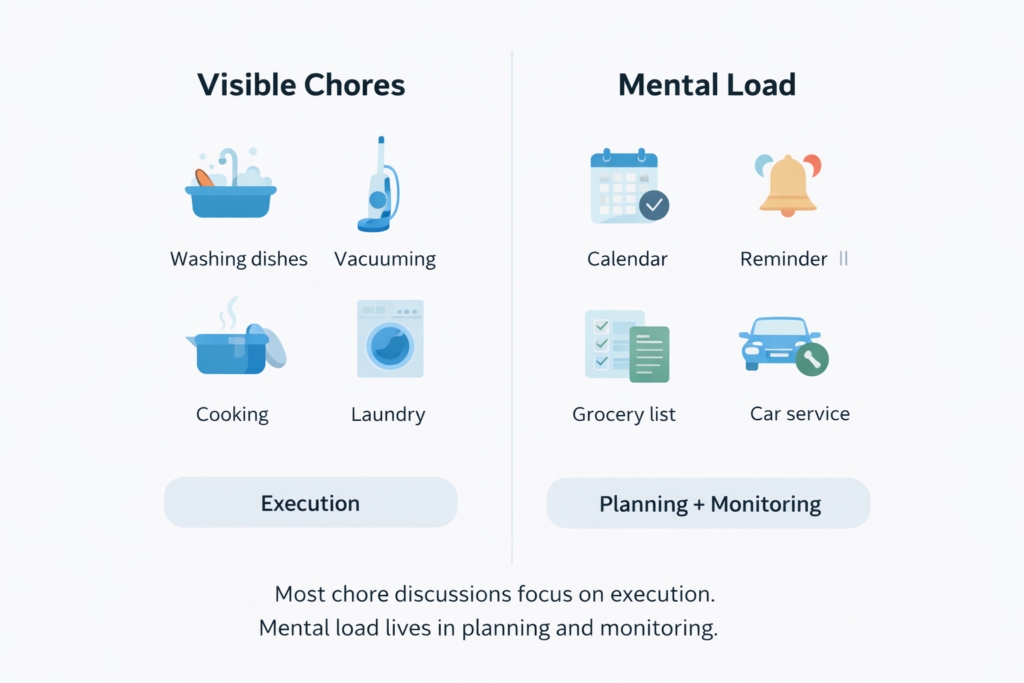
Most discussions about housework focus on visible tasks.
Dishes.
Laundry.
Cleaning.
These tasks are easy to observe, measure, and divide.
What remains invisible is the work that happens before the task begins.
Someone notices groceries running low.
Someone remembers that the car service is overdue.
Someone keeps track of which bills need attention this week.
This layer of responsibility sits above the physical work. It requires attention, memory, and ongoing monitoring.
When one partner carries this layer consistently, they become responsible for the entire system of the household.
Even if chores appear evenly divided on paper, the invisible work continues accumulating in one direction.
The Mental Load Behind Everyday Tasks
Psychologists often describe this invisible work as the mental load of running a household.
Mental load includes several kinds of effort that rarely appear on chore lists.
Anticipating future needs.
Planning tasks that have not yet happened.
Tracking deadlines and schedules.
Monitoring whether things have been completed.
Consider something simple like dinner.
Cooking the meal is one task. Planning what the household will eat for the week, checking which ingredients are available, and remembering to buy missing items is another layer entirely.
The person who performs that planning work is managing the system.
When this responsibility consistently falls on one partner, the imbalance becomes emotionally heavy. Over time it can produce frustration, resentment, and a feeling of being the only responsible adult in the home.
Why Chore Charts Often Fail
Many couples try to solve this problem by creating a chore chart.
The idea seems logical. Divide the tasks evenly and the imbalance should disappear.
In practice, chore charts often fail for a simple reason.
They divide execution, not responsibility.
Someone still needs to notice that the trash is full. Someone still needs to remember that laundry day has arrived. Someone still needs to initiate the task.
If that trigger continues to come from the same person, the mental load remains unchanged.
You can see this dynamic more clearly in many traditional couples chore chart systems. They assign tasks but leave the responsibility for noticing those tasks untouched.
The result is predictable. One partner still feels like the manager of the system.
The Hidden Trigger That Creates the Imbalance
The real difference between balanced and unbalanced households lies in a small but powerful question.
Who initiates the task?
The partner who consistently initiates action becomes responsible for the household’s functioning.
They notice when the sink begins to fill with dishes.
They decide when groceries need replenishing.
They remember appointments.
Over time this role expands. The partner initiating tasks becomes the default coordinator of the home.
This dynamic is rarely intentional. It develops through habit and convenience. Yet once established, it becomes difficult to change.
The imbalance persists because initiation remains concentrated in one person.
How One Partner Becomes the Default Manager
When initiation is uneven, a feedback loop forms.
The partner who initiates tasks begins doing so more frequently because they anticipate problems earlier. The other partner grows accustomed to responding only when asked.
Eventually the first partner becomes the default owner of the system.
They carry the responsibility for noticing problems, triggering action, and ensuring completion.
This dynamic is explored in detail in the concept of default ownership in relationships, where one person unintentionally becomes responsible for initiating nearly every household task.
Once this pattern is established, even helpful partners may feel disconnected from the system because they are not involved in its triggers.
A Structural Fix: Default Ownership
Solving the imbalance requires a shift in how responsibility is defined.
Instead of dividing tasks evenly, couples benefit from assigning default ownership of areas or categories within the household.
Default ownership means one partner is responsible for initiating action within a defined zone.
For example:
Kitchen ownership might include noticing when groceries run low and triggering the shopping plan.
Laundry ownership might include recognizing when loads need to be started.
Entryway ownership might include maintaining the drop zone where shoes, bags, and keys accumulate.
The key idea is that ownership includes initiation, not just execution.
This reduces the constant need for reminders and negotiation.
What Shared Responsibility Actually Looks Like
When ownership becomes clear, the system of the home begins to stabilize.
A partner responsible for the kitchen notices when ingredients are running low and plans accordingly. The other partner might still cook or help with dishes, but the initiation remains anchored.
Another partner might own laundry. They monitor when loads need to run and ensure the cycle begins.
Each area has a trigger.
This structure removes the invisible work of constant coordination from a single person.
Many couples discover that once ownership is clear, cooperation becomes easier. Tasks happen earlier. Friction decreases.
Why Structure Reduces Conflict
Arguments about housework often appear emotional on the surface. Underneath, they usually reflect repeated uncertainty about responsibility.
When ownership is unclear, tasks are negotiated repeatedly.
“Can you take care of this?”
“Did anyone remember that?”
“Why didn’t this get done?”
A structured system removes much of that negotiation.
Each partner knows which areas they monitor. Each person knows where initiation belongs.
The household becomes less reactive and more predictable.
A System That Prevents the Drift
For many couples, assigning ownership is only one part of the solution.
Homes also benefit from simple rhythms that prevent small problems from accumulating.
A weekly reset routine, daily neutral habits, and clearly defined zones can stabilize the environment so that responsibility does not become overwhelming.
These ideas are explored more fully in the Done By Sunday Home Reset Framework, which introduces a simple structure for maintaining household order without constant effort.
Combined with ownership rules, these systems help transform the home from a source of friction into a predictable environment.
The Missing Piece: Responsibility Architecture
Many couples try to divide chores evenly. The difficulty is that chores are only the visible layer of household work.
The deeper issue is who owns the trigger that starts the task.
Responsibility Architecture solves this by assigning default ownership of household areas rather than simply dividing tasks.
Ownership means three things:
- noticing when something needs attention
- initiating the action
- ensuring the task reaches completion
When ownership is clearly defined, the constant reminder loop disappears. Each partner monitors specific zones of the household instead of waiting to be asked.
This structure is explained in more detail in the Responsibility Architecture system, which shows how couples can assign ownership in a way that keeps the home running without one person becoming the default manager.
When the System Starts Working
The shift can feel surprisingly small.
Instead of one partner monitoring everything, responsibility is distributed through ownership and rhythm.
Tasks happen earlier.
Reminders decrease.
Resentment fades.
Most importantly, the invisible work becomes visible and shared.
The partner who once felt responsible for everything no longer carries the entire system alone.
And the partner who once felt reactive becomes an active part of the structure.
The Real Problem Was Never Effort
Most couples are willing to help each other.
The difficulty lies in the invisible coordination required to run a home smoothly.
When that coordination rests on one person, imbalance becomes inevitable.
When responsibility is structured clearly, the same household tasks begin to feel lighter.
The goal is not perfection. The goal is a system where both partners understand how the home operates and where their responsibility begins.
That clarity is what finally replaces the feeling that one person is doing everything.
Two complementary systems help couples restore balance:
• Responsibility Architecture, which clarifies ownership and removes the reminder loop
• Home Reset Framework, which stabilizes the home through simple weekly structure