
You’re not doing everything.
But you’re thinking about everything.
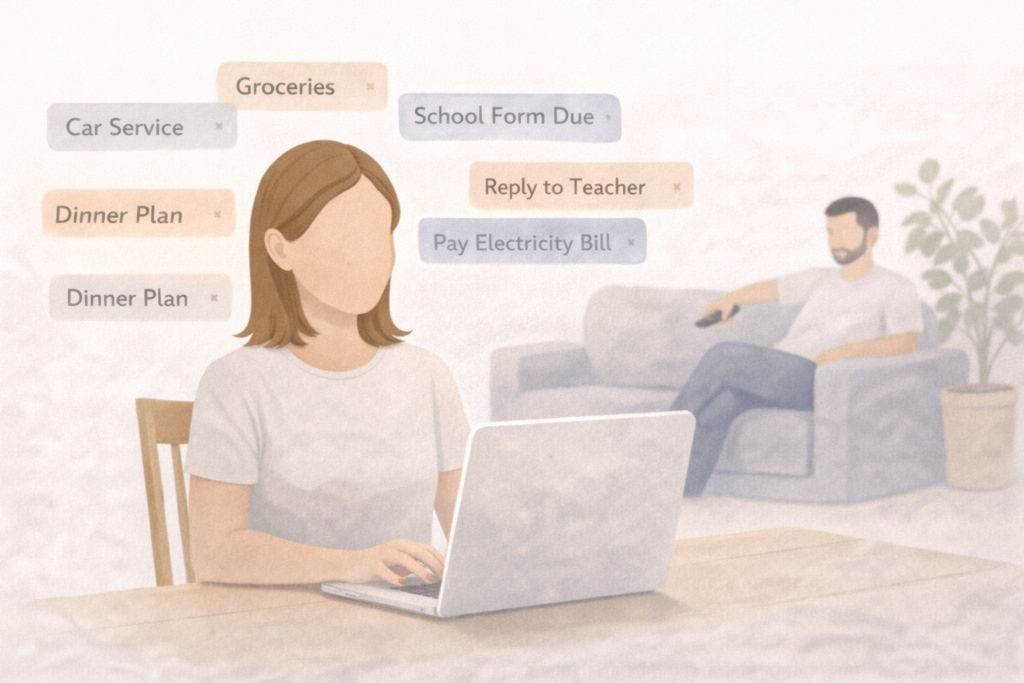
Groceries. School emails. The appointment that needs to be booked next week. The bill that’s due soon. The detergent that’s almost empty. The birthday gift that shouldn’t be forgotten.
Nothing dramatic is happening. The home functions. Tasks get done. But underneath the visible work, there is a quiet layer of vigilance.
If that sounds familiar, you may be carrying the mental load.
This article is not about blaming a partner. It is about recognizing patterns. Mental load rarely announces itself clearly. It shows up as small signals that are easy to dismiss, until the weight becomes noticeable.
Here are some of the most common signs of mental load in a relationship, and what they usually mean.
Table of Contents
1. You Are the Default Planner
You think ahead before problems appear.
You plan meals before the week starts. You check calendars before confirming commitments. You anticipate scheduling conflicts before they turn into last-minute scrambles.
Planning is preventive work. It keeps friction from surfacing.
Because prevention is invisible, it often goes unnoticed. No one sees the problem that didn’t happen. But the cognitive effort behind that stability is real.
If you consistently find yourself thinking three steps ahead while your partner reacts when something becomes urgent, that planning layer may be concentrated with you.
That doesn’t mean your partner is careless. It means the forward-looking layer of responsibility has settled somewhere specific.
2. You Notice Gaps Before Anyone Else
You realize the milk is low before it runs out. You notice the school portal update before it becomes a missed deadline. You remember that the car service is due soon.
Monitoring is ongoing awareness.
It does not look like a task. It looks like attention. But attention requires mental bandwidth. When you are scanning constantly, you are carrying part of the home’s invisible infrastructure.
Many people carrying the mental load describe this as “always having a mental checklist running in the background.”
If you feel that quiet background tracking rarely switches off, that is a signal.
Awareness itself is work.
3. You Feel Responsible for Reminders
You don’t just notice what needs to happen. You prompt it.
“Can you take the trash out?”
“Did you reply to that email?”
“We need to book that appointment.”
Over time, reminders become routine. And routine reminders are rarely neutral.
Repeated prompting is often interpreted as nagging. But structurally, reminders indicate something else: initiation is unclear.
When no one explicitly owns the trigger for a task, it floats. The person who notices first initiates. If that person is consistently you, reminders become part of your role.
If you recognize this pattern, it may be helpful to explore clearer ownership rather than trying to “communicate better” alone.
(You can read more about this in our article on default ownership in a relationship.)
4. You Feel Tired Even When Tasks Are Shared
On paper, things look balanced.
One of you cooks. The other shops. One handles laundry. The other manages bills.
Yet you still feel overloaded.
This is one of the most confusing aspects of mental load imbalance. Execution may be divided evenly, but cognitive responsibility may not be.
If you are the one tracking whether groceries are needed, planning what to buy, and reminding when to go — even if someone else does the shopping — you are carrying more than half of the invisible layer.
Physical effort and cognitive load are not the same thing.
If you feel drained despite visible fairness, the imbalance may sit in planning, monitoring, or initiation rather than execution.
5. You Get Irritated Before You Ask for Help
You notice irritation rising before any conversation has happened.
You think, “Why do I always have to bring this up?” or “Why am I the only one thinking about this?”
That irritation is rarely about the specific task. It is about vigilance.
When you are constantly scanning for gaps, even small oversights can feel symbolic. They reinforce the sense that the system depends on you noticing.
This does not mean you are overreacting. It means your mental bandwidth may be stretched.
When responsibility is informal and initiation unclear, frustration accumulates quietly before it surfaces verbally.
6. You Stop Asking Because It Feels Easier
At some point, you may stop prompting altogether.
You take over because explaining feels heavier than doing it yourself.
This often happens when reminder loops repeat without structural change. It feels simpler to execute than to re-negotiate.
But over time, this reinforces the imbalance. The system adapts to the more vigilant partner absorbing more responsibility.
This is how mental load becomes invisible again. Not because it disappears, but because one person quietly integrates it into their role.
If you recognize this shift, it is worth pausing. Avoiding conflict by absorbing more responsibility rarely leads to sustainable balance.
7. You Feel Invisible in Everyday Logistics
There is a subtle feeling that your effort is hard to see.
Because much of the work you do prevents problems rather than solving them, it rarely receives acknowledgment. Stability becomes the baseline, and the cognitive effort behind it fades into the background.
This invisibility is common in mental load imbalance. The home runs smoothly, but the operator feels unseen.
That emotional layer matters. It is not about praise for every task. It is about shared visibility of the full system.
When invisible work remains unnamed, it is difficult to rebalance it.
What These Signs Actually Mean
If several of these signs feel familiar, it does not automatically mean your partner does not care.
It does not mean you are more competent, or your relationship is fundamentally unequal.
Most often, it means ownership is unclear.
When planning, monitoring, and initiation are not explicitly assigned, they drift toward the more vigilant partner. The system depends on the person who notices sooner.
Mental load imbalance is usually structural before it is personal.
Once you see that, the conversation changes. Instead of asking, “Why am I doing everything?” the question becomes, “How is responsibility structured?”
That shift matters.
What To Do If These Signs Feel Familiar
You do not need a dramatic overhaul. You need clarity.
Start by making the invisible visible. List recurring responsibilities, including planning and coordination, not just physical tasks.
Then clarify initiation. For each domain, define who owns the trigger. Who notices when it needs attention? Execution can remain flexible, but the trigger should be explicit.
Next, calibrate load. Consider frequency, time, and friction. A daily five-minute task may carry more cumulative weight than a monthly one-hour task.
Finally, install a simple weekly alignment rhythm. A short, predictable review prevents drift and keeps adjustments procedural rather than emotional.
Responsibility Architecture™ was designed around this invisible layer. Not to divide chores mechanically, but to clarify ownership across planning, monitoring, and initiation. When that layer becomes explicit, reminders reduce naturally.
From Vigilance to Structure
Mental load feels personal when it is invisible.
It feels like you care more. Or notice more. Or manage better.
But in most homes, the issue is not care. It is clarity.
When responsibility becomes visible and ownership explicit, the background vigilance softens. You no longer have to hold the entire mental dashboard alone.
That shift is rarely loud. It is steady.
And steady systems are what reduce mental load over time.