
Most couples say certain responsibilities are “shared.”
Shared bills. Shared groceries. Shared cleaning. Shared childcare.
On paper, that sounds fair.
In practice, one person often ends up being the one who notices, tracks, and initiates those shared tasks. They don’t necessarily do all the work. But they are the trigger.
That trigger layer is what we call default ownership in a relationship.
If you’ve ever wondered why tasks feel uneven even when effort looks balanced, this concept explains it.
Table of Contents
What Default Ownership In A Relationship Actually Means
Default ownership in a relationship answers one simple question:
Who notices when this needs to happen?
Not who performs it.
Not who helps.
Not who steps in occasionally.
Who is responsible for the trigger?
In most homes, there are three different layers of responsibility:
- Execution (doing the task)
- Monitoring (keeping track of when it’s needed)
- Initiation (starting it without prompting
Execution is visible. Monitoring and initiation often are not.
You can divide execution evenly and still have initiation concentrated in one person. When that happens, mental load accumulates there.
Default ownership lives in the initiation layer. It clarifies who carries the trigger so that reminders don’t become routine.
Why Shared Tasks Without Default Ownership Drift
“Shared” sounds cooperative. It also creates ambiguity.
When a responsibility belongs to both people, it often belongs to neither in a concrete way. Someone eventually notices. Someone eventually says something.
If that someone is predictable, imbalance forms quietly.
The pattern looks like this:
- Task is described as shared.
- No one explicitly owns the trigger.
- One partner notices friction sooner.
- That partner initiates.
- Over time, they initiate most of the time.
Nothing dramatic happens. No formal decision is made. The system simply drifts toward the more vigilant partner.
This drift is one of the primary causes of mental load imbalance. The partner who monitors and initiates repeatedly begins to feel like the system depends on them.
It is not a character flaw. It is a structural gap.
The Three Layers of Ownership
To understand default ownership clearly, it helps to separate responsibility into layers.
1. Planning Ownership
Planning is forward-looking responsibility.
Who thinks about meals before the week starts?
Who anticipates scheduling conflicts?
Who books appointments before they become urgent?
If planning consistently sits with one partner, they carry a disproportionate share of cognitive weight even if execution is shared.
Planning prevents friction, which means it often goes unnoticed. But it is foundational.
2. Monitoring Ownership
Monitoring is ongoing awareness.
Who keeps track of supplies running low?
Who checks school portals or email updates?
Who notices that maintenance is due?
Monitoring requires attention. Attention consumes energy.
If one partner runs the mental dashboard of the home, they are effectively acting as the operating system. They may not do every task, but they are responsible for making sure tasks happen.
That role feels heavy over time.
3. Initiation Ownership
Initiation is the trigger.
Two partners might both be willing to do groceries. But who decides it’s time? Who says, “We need to restock”?
If one person consistently initiates without being asked, they carry default ownership whether it was formally assigned or not.
When initiation remains centralized, reminders become inevitable. Reminders then turn into frustration. The frustration gets misinterpreted as nagging.
Underneath it, the structure never clarified the trigger.
What Default Ownership Is Not
When people hear the word “ownership,” they sometimes assume rigidity.
Default ownership is not:
- Permanent assignment.
- A rigid role that never changes.
- A return to outdated gender patterns.
- Control over the other partner.
It is clarity of trigger.
Ownership can rotate. It can evolve. It can be renegotiated during life transitions.
What matters is that it is explicit.
Without explicit ownership, ambiguity fills the gap. And ambiguity always settles somewhere.
Why Default Ownership Reduces Conflict
Conflict around chores is rarely about the task itself.
It is about repeated reminders.
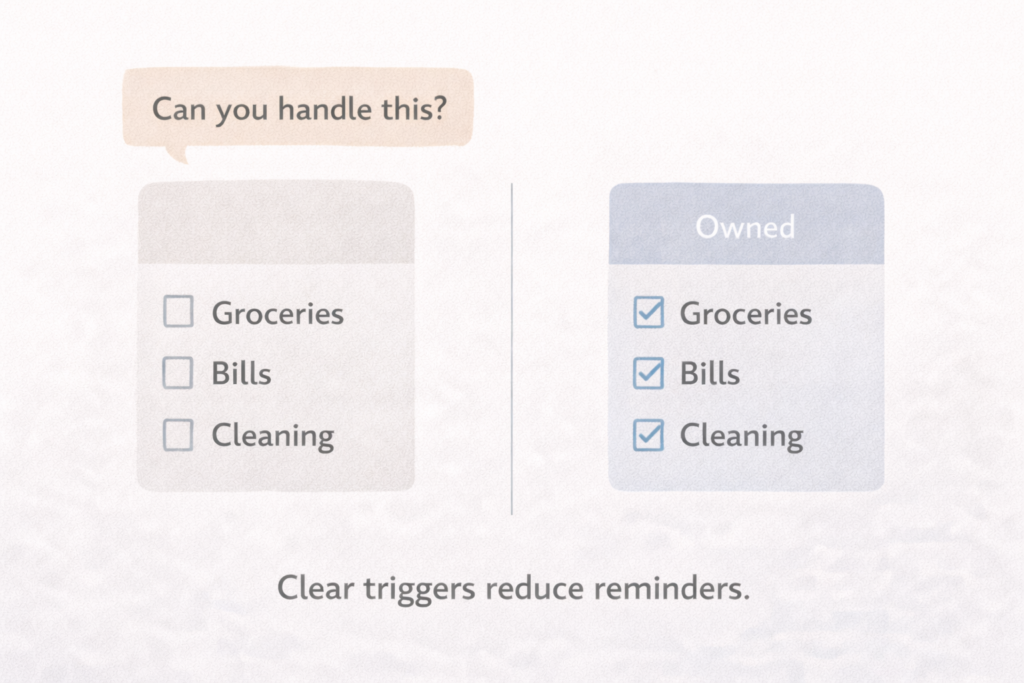
When one partner must repeatedly say, “Can you handle this?” they are not only delegating execution. They are carrying initiation.
That pattern creates tension on both sides.
The initiator feels burdened.
The other partner feels criticized.
When default ownership is clear, reminders decrease because triggers are internalized.
The trash goes out because it belongs to someone by default. Groceries are restocked because someone owns that domain. Bills are paid because monitoring is explicit.
Trust increases when tasks happen without prompting.
The emotional temperature of daily logistics drops.
From Fairness to Structure
Many couples aim for fairness by dividing tasks evenly.
But counting tasks is not the same as calibrating load.
A daily five-minute task may weigh more than a monthly one-hour task. A coordination-heavy task may feel heavier than a mechanical one.
Default ownership works best when paired with load calibration.
Instead of asking, “Are we doing the same number of tasks?” the better question becomes, “Is the cognitive load distributed sustainably?”
That shift moves the conversation from fairness to structure.
Structure is easier to adjust than personality
How to Install Default Ownership in a Shared Home
This does not require a complicated system. It requires deliberate clarity.
Step 1: Map Recurring Domains
List all recurring responsibilities. Include planning, monitoring, and coordination, not just visible chores.
Seeing the full map often changes the tone of the conversation immediately.
Step 2: Assign Default Triggers
For each domain, define who owns initiation.
Who notices when it needs attention?
Who ensures it is not forgotten?
Execution can remain flexible. But the trigger belongs somewhere specific.
Step 3: Calibrate Load
Review frequency, time, and friction.
If one partner owns several high-frequency domains, adjust deliberately. Sustainable balance matters more than symmetry.
Step 4: Install a Review Rhythm
Life changes. Work shifts. Children’s needs evolve.
A short weekly alignment prevents drift. It creates a predictable space to adjust ownership without waiting for tension to surface.
Without rhythm, even good structures erode.
What It Feels Like When Default Ownership Is Clear
The change is rarely dramatic.
You stop scanning everything by default.
You trust that certain domains are covered.
You no longer feel responsible for prompting every task.
Conversations become shorter and more neutral. If something slips, the discussion references structure rather than character.
Instead of “You never remember,” the tone becomes, “This domain may need clearer ownership.”
That subtle shift removes much of the emotional charge from everyday logistics.
Why This Concept Matters Long-Term
Default ownership in a relationship is not just about chores.
It affects trust. Stability. Emotional bandwidth.
When one partner becomes the invisible operator of the household, strain accumulates quietly. When ownership is explicit, responsibility becomes procedural.
Procedural problems are easier to solve.
For couples who prefer clarity over repeated negotiation, installing ownership infrastructure changes the tone of the home quickly.
Responsibility Architecture™ was designed around this principle. Not to divide chores mechanically, but to define ownership clearly across planning, monitoring, and initiation layers.
When ownership is visible and calibrated, reminders reduce naturally. Mental load distributes more evenly. The system no longer depends on one person’s vigilance to function.
That is what default ownership does.
It moves the home from reactive reminders to structured responsibility.