
If you’ve ever thought, “I don’t want to nag… but if I don’t say anything, it won’t get done,” you’re not alone.
Most people who feel like they are nagging didn’t start out that way. They started out reminding. Then prompting. Then repeating. Eventually the tone changes, even when the intention hasn’t.
Underneath the frustration is usually a deeper question:
How do I stop nagging about chores without quietly taking over everything?
The answer isn’t about being quieter. It’s about redesigning the structure that keeps putting you in that position.
Table of Contents
Why Nagging Starts in the First Place
Nagging rarely begins with control. It begins with uncertainty.
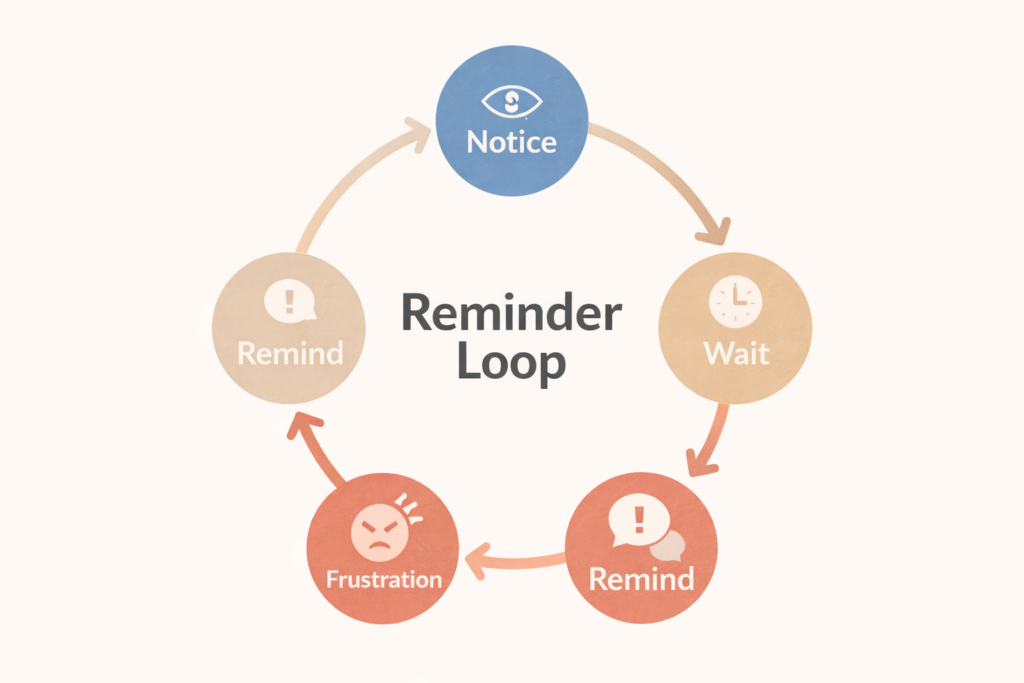
You notice the trash is full. You wait. It’s still full. You mention it casually. Nothing happens. You remind again. Now you sound irritated.
From the outside, it looks like repetition.
From the inside, it feels like responsibility.
Nagging is often a signal that one partner is carrying the initiation layer of the home. They are the one who notices, tracks, and triggers tasks. The reminder isn’t about the trash. It’s about being the default monitor.
If initiation remains centralized, reminders become predictable. Predictable reminders become tension.
That cycle has very little to do with personality. It has everything to do with unclear ownership.
The Reminder Trap
In many homes, tasks are described as “shared.”
Groceries are shared. Cleaning is shared. Bills are shared.
But shared without defined triggers creates ambiguity. When does the task officially begin? Who is responsible for noticing that it needs to happen?
In that ambiguity, one partner often steps in first. They are more sensitive to friction. They anticipate consequences. They prefer prevention over recovery.
So they remind.
At first, reminders feel harmless. Over time, they become the infrastructure.
If you are always the one who reminds, you are still carrying the cognitive responsibility even when the physical task is done by someone else.
That is why nagging feels exhausting. It isn’t just words. It is management.
Why “Just Stop Reminding” Doesn’t Work
Some advice suggests pulling back. Stop reminding. Let things fail. Allow natural consequences.
In theory, that sounds empowering.
In practice, it can create more stress.
If the bill is missed, the late fee affects both of you. If groceries aren’t bought, dinner becomes chaotic. If laundry piles up, everyone feels the friction.
When the cost of failure is shared, the person who cares more about stability often resumes reminding.
So the cycle continues.
You don’t need less caring. You need clearer structure.
The Difference Between Execution and Ownership
A common misunderstanding is that dividing chores equally solves nagging.
It helps, but it doesn’t go far enough.
You can agree that one partner handles trash and the other handles dishes. But if someone still has to say, “Hey, the trash is full,” ownership hasn’t shifted. Initiation is still centralized.
Ownership means being responsible for noticing and triggering the task without being prompted.
Execution is the act. Ownership is the trigger.
Nagging happens when execution is assigned but ownership is not.
Why It Feels Personal
When you remind repeatedly, it can start to feel like your partner doesn’t care.
When your partner hears reminders, they may feel criticized.
Both interpretations are emotional. Neither addresses the structural root.
The real issue is often this: no one explicitly decided who owns the trigger.
In the absence of clarity, someone absorbs it.
That absorption eventually turns into resentment.
Not because the task is difficult, but because being the default initiator is invisible labor.
How to Stop Nagging Without Doing It All Yourself
Stopping nagging is not about suppressing frustration. It is about removing the structural conditions that create repeated reminders.
There are four shifts that make a measurable difference.
1. Make the Invisible Visible
Before you can redistribute responsibility, you need to see it fully.
List recurring tasks, but go beyond physical chores. Include planning, monitoring, scheduling, and tracking.
Who monitors school updates?
Who tracks supplies running low?
Who anticipates maintenance tasks?
When both partners can see the full recurring structure, reminders stop feeling like personality traits and start looking like system gaps.
Visibility changes the tone of the conversation.
2. Assign Default Ownership
Every recurring responsibility needs a default owner.
Default ownership does not mean permanent burden. It means clear trigger.
It answers one question: who notices when this needs to happen?
When trash belongs to one person by default, they monitor fullness. They decide when it goes out. The other partner does not have to prompt.
If groceries belong to one partner, that person tracks inventory and timing. The other does not have to initiate.
Execution can still be flexible. Help can still be offered. But initiation becomes explicit.
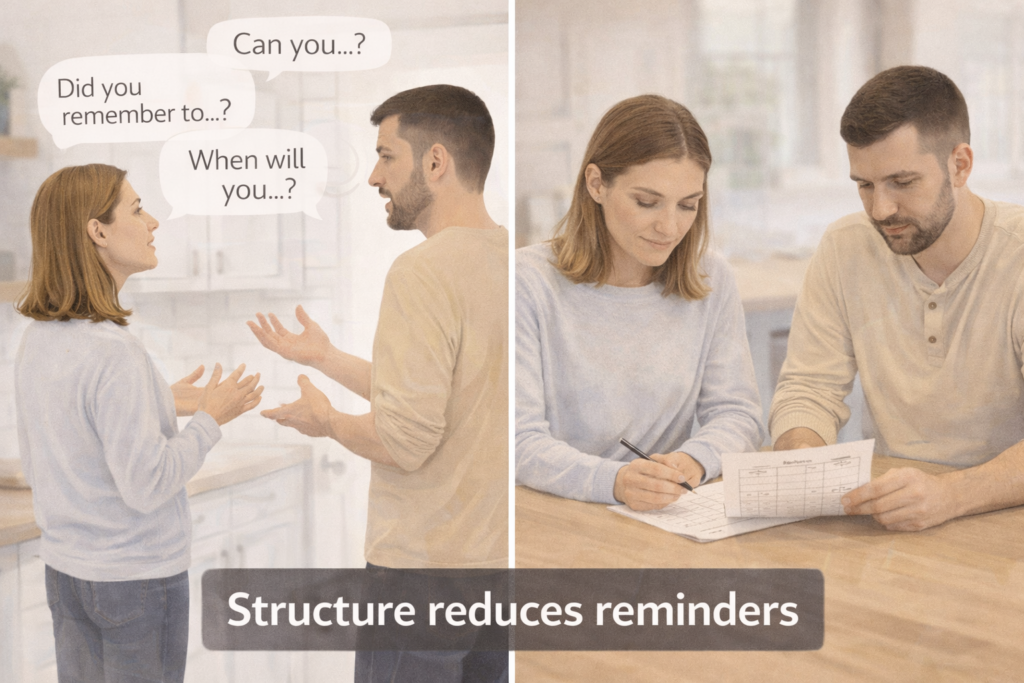
Clear triggers eliminate most reminders.
3. Calibrate the Real Load
Not all chores carry equal weight.
A five-minute task that happens daily can weigh more than a monthly one-hour task. Coordination tasks often carry more mental strain than mechanical ones.
If one partner owns several high-frequency, high-friction domains, reminders will continue because pressure remains uneven.
Calibrating load means looking at frequency, time, and friction together.
The goal is not mathematical symmetry. It is sustainable balance.
When load feels balanced, reminders decrease naturally.
4. Install a Review Rhythm
Even a well-designed structure drifts over time.
Work schedules shift. Energy fluctuates. Children’s activities change.
Without a defined review rhythm, small imbalances accumulate quietly.
A short weekly alignment prevents that drift.
This meeting does not need to be long. It needs to be predictable. It creates a space to adjust ownership calmly instead of renegotiating midweek under stress.
When review becomes procedural, reminders become rare.
What Changes When Structure Is Clear
When ownership is explicit, something subtle shifts.
You stop scanning every domain by default.
You trust that certain areas are covered.
You no longer feel responsible for prompting everything.
Conversations become shorter and more neutral.
Instead of, “I always have to remind you,” the tone shifts to, “This domain might need clearer ownership.”
That small shift lowers defensiveness dramatically.
Nagging fades not because someone became more patient, but because reminders are no longer necessary.
What If Your Partner Resists Structure?
Sometimes resistance is not about unwillingness. It is about fear of rigidity.
Structure does not eliminate flexibility. It clarifies triggers.
Explain that the goal is not to assign blame or lock roles permanently. The goal is to remove repeated friction.
Frame the conversation around reducing reminders for both of you.
When the benefit is mutual, structure feels less like control and more like relief.
When Nagging Is a Structural Signal
If you find yourself thinking, “I hate that I sound like this,” that is important.
Most people who nag do not enjoy it. They feel pushed into it.
Nagging is often a symptom of centralized initiation.
When one partner carries most of the monitoring and triggering, reminders are inevitable.
You do not need to silence yourself. You need to rebalance responsibility.
For couples who prefer clarity over repeated negotiation, installing explicit ownership infrastructure changes the pattern quickly.
Responsibility Architecture™ was designed for this layer of friction. Not for aesthetics. Not for deep cleaning. For the invisible triggers that keep creating reminders.
When ownership is visible and calibrated, you stop managing your partner.
You start managing the system together.
And that is how nagging fades without you having to do everything yourself.