
Table of Contents
A cleaning schedule for working couples has to fit around real workdays, not ideal ones. When both partners are managing full-time jobs, commuting, deadlines, and evening fatigue, the schedule cannot depend on spare energy that rarely exists.
Most weekly plans look reasonable at first glance. They spread tasks across seven days and assume steady motivation. By midweek, that structure starts to strain. Small resets get skipped. One evening turns heavier than expected. The schedule quietly collapses.
A realistic weekly cleaning plan does something simpler. It protects short weekday windows, interrupts buildup before Friday, and restores the home in one defined block. It respects shared responsibility without turning every evening into a negotiation.
This guide walks through a weekly schedule that holds under normal work pressure, not just during calm weeks.
What a Realistic Cleaning Schedule Must Respect
Before assigning tasks to specific days, it helps to clarify what the schedule must protect. When both partners work full time, the constraint is not knowledge. It is energy.
Limited Weekday Capacity
Weeknights are short. Dinner, basic unwinding, and preparation for the next day already occupy most of that window. A schedule that demands forty-five minutes of cleaning on a Tuesday competes with recovery.
A realistic plan keeps weekday tasks small enough that they can be completed even on an average, slightly tired evening. If a task regularly feels optional, it will eventually be skipped.
Predictable Fatigue Patterns
Energy often dips midweek. By Thursday, even simple tasks feel heavier than they did on Monday. A schedule that front-loads large tasks into those low-energy days creates friction.
Instead, the plan should interrupt buildup before it compounds. A short stabilizing session in the middle of the week keeps surfaces from tipping into overwhelm.
Shared Responsibility Without Ongoing Negotiation
When both partners contribute, the schedule needs clear initiation points. “We’ll do it later” stretches into the weekend. “Who is handling this?” turns into a conversation neither person wants to have at 9:30 p.m.
A realistic schedule assigns ownership in advance. It reduces decision-making in the moment.
Containment Over Perfection
The purpose of a weekly cleaning schedule is maintenance. It keeps high-impact areas functional and calm. It does not attempt to deep clean every room.
When the plan respects limited capacity, fatigue patterns, shared ownership, and containment, it becomes something you can repeat. Repeatability is what makes it work.
This schedule builds on the layered routine explained here.
The Core Weekly Cleaning Schedule (Day-by-Day Breakdown)
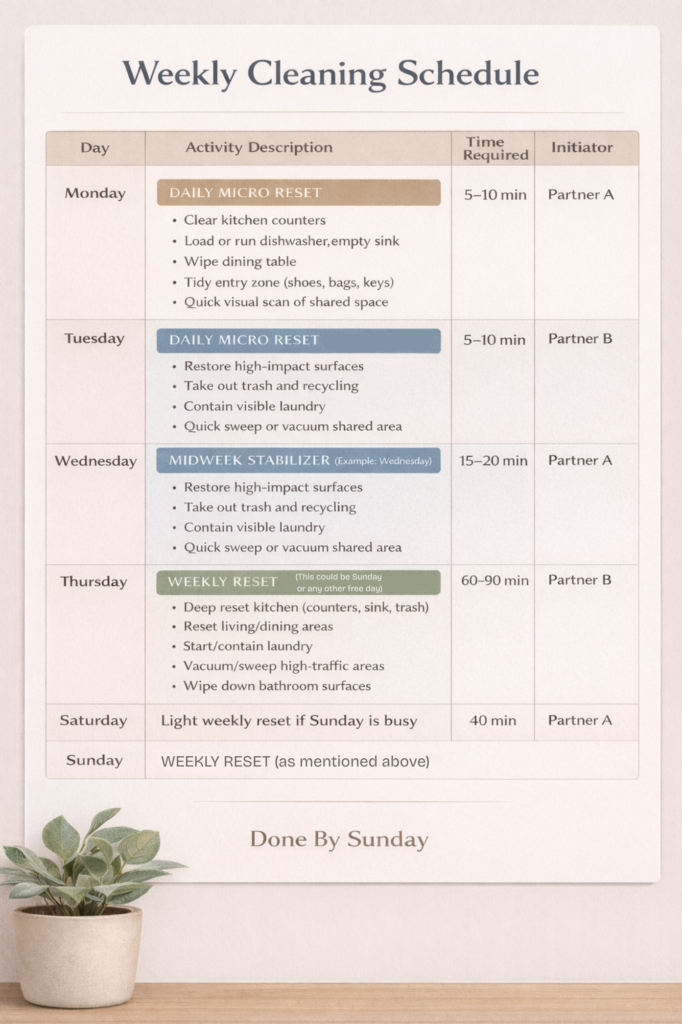
This schedule assumes both partners work full time and return home in the evening. It protects weekday energy, interrupts buildup midweek, and restores baseline control once per week.
You can adjust the exact days. What matters is consistency.
Monday to Thursday: Daily Micro Reset (5–10 Minutes)
Each weekday evening, anchor a short reset to something you already do. After dinner works well. So does right before getting ready for bed.
During this window:
- Clear kitchen counters of non-essential items
- Load or run the dishwasher; leave the sink empty
- Wipe the dining table
- Align the entry area (shoes, bags, keys)
- Quick visual scan of shared space
Set a timer. Stop when it ends.
These resets prevent visible drift from carrying into the next day. They do not include vacuuming every room or reorganizing storage. They restore neutral and protect the next morning.
Wednesday (Example Midweek Stabilizer): 15–20 Minutes
By midweek, small accumulations start to feel heavier. This short stabilizer interrupts that pattern.
Choose one consistent evening, often Wednesday.
During this block:
- Restore any high-impact surface that has drifted
- Take trash and recycling out
- Contain visible laundry
- Quick sweep or vacuum of the most-used area
Avoid expanding scope. The goal is to prevent Friday from absorbing the entire week’s buildup.
When this midweek session happens consistently, the weekend no longer begins in catch-up mode.
Sunday (or Another Fixed Day): Weekly Reset (60–90 Minutes)
Block one defined window. Treat it as maintenance, not punishment.
Focus on:
- Full kitchen reset (counters, sink, trash, quick fridge check)
- Reset living and dining areas
- Start or contain laundry
- Vacuum or sweep high-traffic areas
- Bathroom surface wipe-down
This session restores baseline control. It does not attempt seasonal decluttering or deep cabinet reorganization.
When daily and midweek layers hold, this weekly reset feels structured rather than overwhelming.
How to Split the Schedule Without Tension
A cleaning schedule works when it reduces negotiation. If every reset requires discussion, it eventually gets delayed. Clear structure lowers friction between partners.
Assign Default Initiators
Instead of dividing every task equally, assign default initiators for each layer. One partner might initiate the weekday micro resets in the kitchen. The other might take responsibility for starting the midweek stabilizer.
Initiation does not mean doing everything alone. It means being the person who says, “Let’s reset now,” and begins.
That small clarity prevents surfaces from waiting on mutual hesitation.
Rotate Weekly if Needed
Work intensity shifts. Some weeks one partner carries heavier deadlines or longer hours. Build rotation into the schedule rather than improvising it during exhaustion.
For example:
- Partner A initiates midweek reset this week.
- Partner B initiates it next week.
The structure stays fixed. The initiator changes.
Use a Low-Energy Adjustment Rule
There will be weeks when one partner is stretched thin. Instead of skipping the routine entirely, agree on a scaled-back version in advance.
If one partner is overloaded:
- Only daily micro resets are required.
- The weekly reset shortens to high-impact surfaces only.
- Full schedule resumes the following week.
Pre-decided adjustments reduce resentment and protect consistency.
Keep the Conversation Specific
Avoid broad statements about effort. Refer to the schedule instead.
“Can you initiate the midweek reset tonight?” is clearer than “We need to clean more.”
A realistic cleaning schedule reduces emotional weight because it replaces ongoing debate with a shared plan. When ownership and timing are defined, the routine becomes easier to follow without friction.
Variations Based on Work Patterns
No two couples share the same work rhythm. The structure holds, but the timing may need adjustment. A realistic cleaning schedule adapts to actual calendars rather than forcing one fixed template.
If One Partner Has Longer Hours
When one partner consistently returns home later, weekday resets should lean lighter for them. The earlier partner can initiate the micro reset, while the later partner takes ownership of the weekly block.
This keeps daily momentum without creating imbalance. The person with longer hours still contributes meaningfully, but in a predictable window.
If Both Have Unpredictable Schedules
Some weeks include late meetings, travel, or sudden deadlines. In those weeks, shift from fixed days to fixed triggers.
Instead of “Wednesday midweek reset,” use: “First evening both are home before 8 PM.”
The layer remains. The timing flexes.
Consistency matters more than the specific day.
If You Travel Frequently
Travel disrupts accumulation patterns. During travel weeks:
- Maintain only daily micro resets.
- Skip the midweek stabilizer.
- Shorten the weekly reset to high-impact surfaces only.
Trying to force a full routine into a travel-heavy week usually leads to abandonment. Shrinking scope preserves momentum.
If Weekends Are Packed
If Sundays are full, move the weekly reset to a shorter Saturday morning block or split it into two 40-minute sessions across the weekend.
The schedule should support your life, not compete with it.
A realistic cleaning schedule is stable because it adjusts without collapsing. The layers remain intact. Only the timing shifts.
A Schedule That Holds Through Real Weeks
A cleaning schedule for working couples does not need to be ambitious. It needs to be repeatable. When weekday resets stay small, midweek drift is interrupted, and one defined weekly window restores baseline control, the home stays steady without constant effort.
The difference is rarely about effort. It is about rhythm.
If this weekly plan feels manageable, keep it simple. Anchor the daily reset. Protect the midweek stabilizer. Treat the weekly block as maintenance, not punishment.
And if you want a structured walkthrough of the weekly layer that fits cleanly into a single session, the 90-Minute Sunday Reset breaks that window down step by step. It builds on this schedule without expanding it.
The goal is not to clean more. It is to build a plan that holds even during normal, tired weeks.
If, after that, you feel ready to install a more comprehensive structure across your week, the 7-Day Home Reset Framework builds it step by step. It helps you define zones clearly, assign ownership deliberately, and lock in a repeatable rhythm that prevents drift.