
Table of Contents
Why decluttering doesn’t work is a quiet frustration many busy couples recognize but rarely articulate. You spend a Saturday clearing closets, filling donation bags, wiping shelves. The home feels lighter. Breathing feels easier. For a week, maybe two, everything holds.
Then the kitchen counter fills again. The dining table becomes a holding zone. A chair gathers clothes that are not quite ready for the hamper.
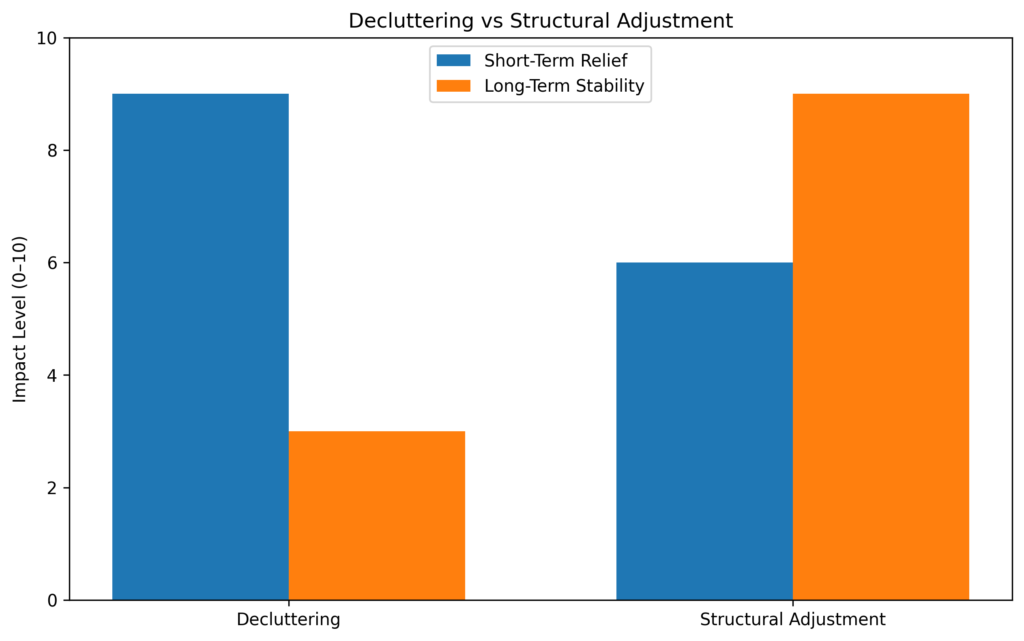
It is tempting to assume you need to declutter more aggressively next time. But when clutter returns this quickly, the issue usually runs deeper than volume. Removing excess creates space. It does not automatically change how that space absorbs daily behavior.
Understanding that distinction shifts the conversation from effort to structure.
What Decluttering Actually Solves
Decluttering has real value. When homes feel heavy or congested, reducing excess can create immediate relief. The mistake happens when couples expect it to solve every kind of disorder.
Volume Overload
Some homes simply contain more than their storage can handle. Closets are packed tightly. Cabinets require stacking. Drawers resist closing. In these cases, removal helps because it reduces pressure on the system.
When volume drops to a manageable level, surfaces stop carrying overflow from crammed storage. This kind of decluttering addresses a clear constraint: there is not enough room for what is being kept.
Expired Decisions
Over time, households accumulate items that represent postponed decisions. Clothes that no longer fit. Duplicate tools. Appliances that no one enjoys using. Paper that no longer requires action.
Removing these clears mental and physical residue. The space feels lighter because unresolved choices have been reduced.
Storage Blockage
Sometimes clutter persists because storage has become obstructed. A drawer near the entry is so full that keys no longer fit comfortably. A cabinet near the sink contains items that belong elsewhere, making everyday use awkward.
Decluttering in these situations restores basic function. Storage begins working again. Surfaces temporarily benefit because they are no longer compensating for blocked spaces.
All of this matters. Removing excess improves usability. What it does not automatically address is how items move through the home each day. If that movement remains unchanged, surfaces may still absorb the same patterns, even in a lighter environment.
Why Clutter Comes Back After You Declutter
When clutter returns soon after a purge, it can feel discouraging. You invested time. You removed excess. The space looked calmer. Yet the same surfaces refill. That usually means the underlying behavior patterns are still intact.
Behavior Has Not Shifted
Most recurring mess forms during predictable windows: after work, after dinner, before bed. Decluttering does not change what happens at 8:30 PM when both partners are tired and placing items down quickly. If the counter was the easiest landing zone before, it often remains the easiest afterward.
The quantity of items may be lower, but the drop pattern stays the same. Over time, repetition rebuilds visual clutter.
Friction Still Exists
Look closely at what it takes to store everyday items. Does putting away mail require sorting immediately? Does storing a bag mean clearing space first? Does hanging a jacket require opening a crowded closet?
If storage demands extra steps during low-energy hours, surfaces become the default alternative. Decluttering may reduce what sits inside drawers, but if those drawers still feel inconvenient, behavior will avoid them.
Ownership Is Still Unclear
Shared homes add another layer. When no one feels responsible for resetting a particular surface, small accumulations linger longer. One partner assumes the other will handle it. The other assumes it is temporary.
Ambiguity allows items to remain visible. Over days, visibility turns into buildup. And that is why decluttering doesn’t work.
Surfaces Still Lack Boundaries
Some counters and tables operate without a defined role. They are used for eating, working, unpacking, sorting, charging, and holding in-between items. Without a clear boundary, they quietly expand their function.
Decluttering can create breathing room. If boundaries remain undefined, that room gradually fills again.
When clutter returns after decluttering, it often signals that the system has not changed. The home feels lighter, but its daily pathways remain the same.
The Difference Between Volume Problems and Structural Problems
Most couples treat clutter as a single category. In practice, it tends to fall into two different patterns. Understanding which one you are facing changes what will actually help.
What a Volume Problem Looks Like
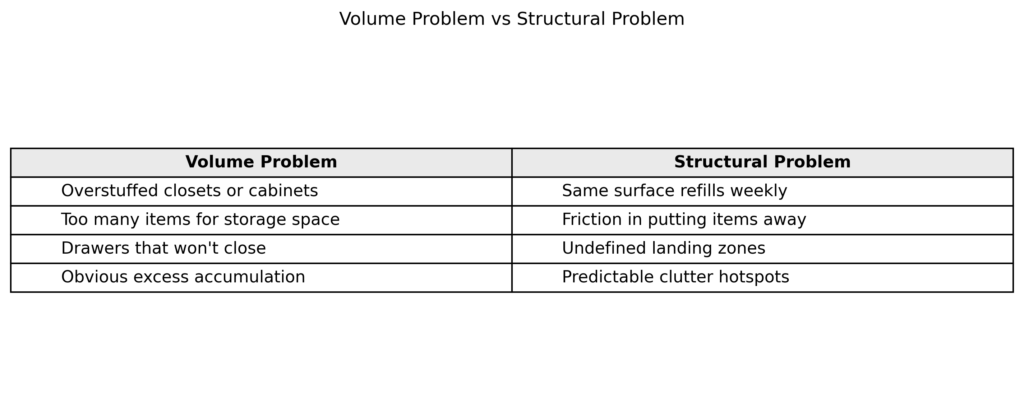
Volume problems are visible and often overwhelming. Closets feel packed. Cabinets require stacking. Storage bins overflow. You struggle to find space for everyday items because too many things compete for the same square footage.
In these situations, reducing what you own genuinely improves function. Drawers close more easily. Shelves breathe. The home feels less congested because pressure on storage decreases.
If the issue is volume, decluttering works because it directly addresses the constraint.
What a Structural Problem Looks Like
Structural problems behave differently. The home may not feel overstuffed overall. Storage may technically have space. Yet the same kitchen counter refills every week. The same chair gathers clothes. The same entry surface accumulates mail and bags.
Here, the issue is not how much you own. It is how daily movement interacts with layout and energy. Items land where friction is lowest. Surfaces without clear boundaries absorb whatever passes through during tired hours.
You can live in a small apartment with relatively few possessions and still experience recurring mess. That is a structural issue. Removing more items will not change where keys are dropped at 9 PM if the nearest tray sits three steps farther than the counter.
Distinguishing between these two patterns prevents unnecessary cycles of purging. If the problem is structural, effort alone will not stabilize it. The design of flow and ownership must adjust.
Why Minimalism Alone Doesn’t Prevent Drift
Owning fewer things can make a home feel calmer. Less volume reduces visual noise and lowers the pressure on closets and cabinets. Many couples experience genuine relief after simplifying.
What minimalism does not automatically change is how people move through their space at the end of a long day.
Fewer Items, Same Evening Patterns
Even in a pared-down home, bags still need to land somewhere. Mail still arrives. Water bottles still migrate between rooms. Jackets still come off when you walk through the door.
If the path from entry to storage involves extra steps or decisions, surfaces near that path will continue to collect items. The total number of objects may be smaller, but the landing behavior remains.
Shared Spaces Still Carry Ambiguity
Minimal homes still require coordination between two adults. If one partner treats the dining table as flexible workspace and the other expects it clear each evening, tension can develop regardless of how little is owned.
Drift often grows from unspoken assumptions, not from excess belongings.
Fatigue Still Influences Choices
Decluttering reduces physical clutter. It does not eliminate decision fatigue. After work, most people prioritize ease. If a counter is within reach and storage requires sorting or stacking, the counter will continue to win.
Minimalism lowers the baseline pressure. It does not design containment for daily movement. Without structural clarity, even simplified homes develop recurring clutter hotspots.
Recognizing this prevents the cycle of repeated purges. The goal shifts from owning less to aligning layout, energy, and ownership in a way that holds under real-life conditions.
What Actually Stops Recurring Mess
Once you recognize that recurring clutter is structural, the solution becomes more practical and less dramatic. You do not need another aggressive purge. You need small adjustments that align layout with real behavior.
Define Neutral for High-Impact Surfaces
Every shared home has a few surfaces that shape how the entire space feels. When those stay clear, the home feels steady. When they fill, everything feels heavier.
Instead of trying to maintain perfection everywhere, identify the few high-visibility zones that influence mood most strongly. Clarify what “clear enough” means for each one. Specific definitions prevent surfaces from slowly expanding their role.
Reduce Friction to Storage
Look at the items that repeatedly land on the same counter or chair. Then examine how easy it is to store them properly.
Can they be placed away in one motion?
Does storage require sorting, bending, or clearing space first?
Is the container already too full?
Small reductions in friction make a measurable difference. When the easier path aligns with the intended path, behavior stabilizes without constant effort.
Clarify Default Ownership
Ambiguity allows clutter to linger. When no one feels responsible for initiating a reset on a surface, it becomes a neutral holding area.
Defining a default owner does not mean one person carries all responsibility. It simply establishes who initiates returning that zone to neutral when it drifts. Clear initiation reduces quiet resentment and shortens the lifespan of accumulation.
Install a Containment Rhythm
Finally, recurring mess slows when there is a consistent rhythm that restores high-impact zones before they destabilize the entire home. This does not require daily deep cleaning. It requires predictable maintenance that matches real energy levels.
Decluttering creates space. Structural adjustments preserve it. When layout, friction, ownership, and rhythm align, surfaces stop absorbing the same overflow week after week.
If You Want a Simple Starting Point
If recurring mess has less to do with volume and more to do with structure, the first step is restoring stability to the surfaces that drift fastest.
Our 90-Minute Sunday Reset is designed specifically for two working adults sharing a small space. It focuses on visible surfaces, clear containment, and restoring a baseline before the week begins. You are not reorganizing drawers or chasing perfection. You are interrupting the drift before it compounds.
You can download it free and test it this weekend. It gives your home a consistent reset point so structural adjustments have room to hold.
When You’re Ready to Formalize the System
As you begin clarifying ownership and defining reset points, you may notice deeper patterns. Certain tasks repeat. Certain responsibilities remain unclear. Drift returns during busy weeks.
If you want a more deliberate framework, the 7-Day Home Reset builds the structure more thoroughly. Over one focused week, it helps you define outcomes, assign ownership clearly, and establish a repeatable weekly reset rhythm so the mental load does not quietly return.