
Table of Contents
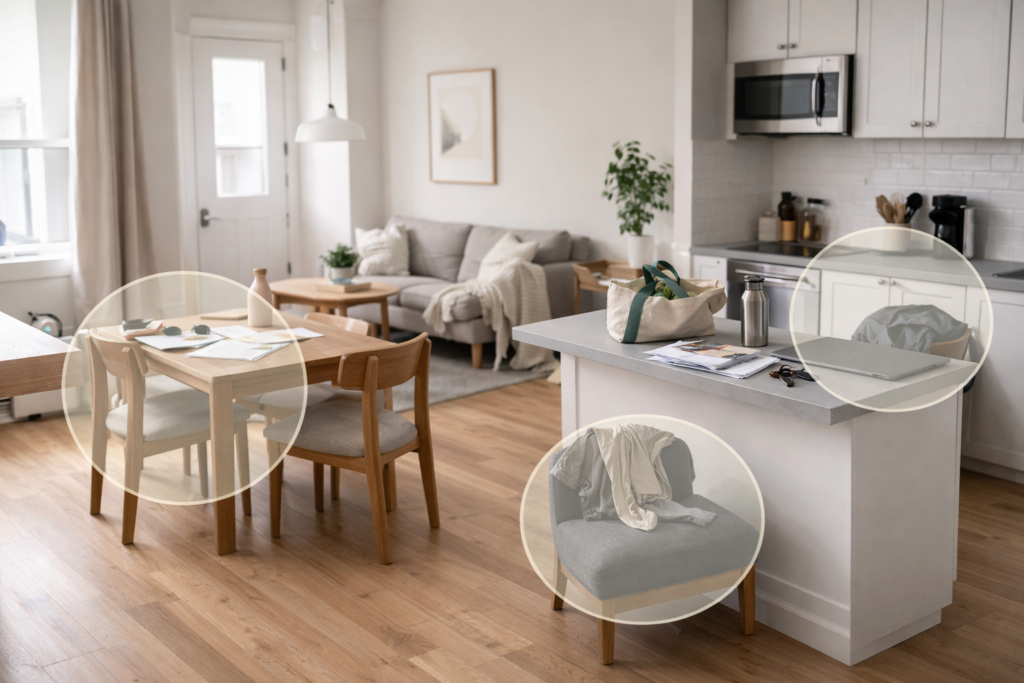
Why clutter returns to the same spots becomes painfully obvious once you start noticing the pattern. The kitchen counter looks clear on Sunday night. By midweek, it’s carrying mail, water bottles, and something that was “just put down for a second.” The entry table fills with keys and bags. One dining chair quietly becomes the overflow closet.
It can feel repetitive and strangely personal, as if the house refuses to cooperate.
In most busy homes, though, these clutter hotspots follow structure. They form where energy drops, where decisions get delayed, and where storage demands one step too many at the wrong time of day. Two working adults coming home tired will always choose the path that costs the least effort. Flat surfaces near entryways and kitchens become landing strips because they sit exactly where behavior naturally slows down.
When clutter keeps returning to the same surface, it is offering information. It highlights friction between how your home is designed and how your evenings actually unfold. Understanding that pattern changes the conversation. Instead of asking who forgot to put something away, you begin asking why that surface keeps absorbing the same items in the first place.
Clutter Is Predictable, Not Random
Most couples describe clutter as chaotic. When you zoom out, it behaves more like a pattern repeating under similar conditions.
Repeated Drop Zones
Every home has default landing areas. They usually sit close to the entrance, near the kitchen, or beside the couch. These are the spots where bags come off shoulders, mail leaves hands, and jackets get draped “for now.”
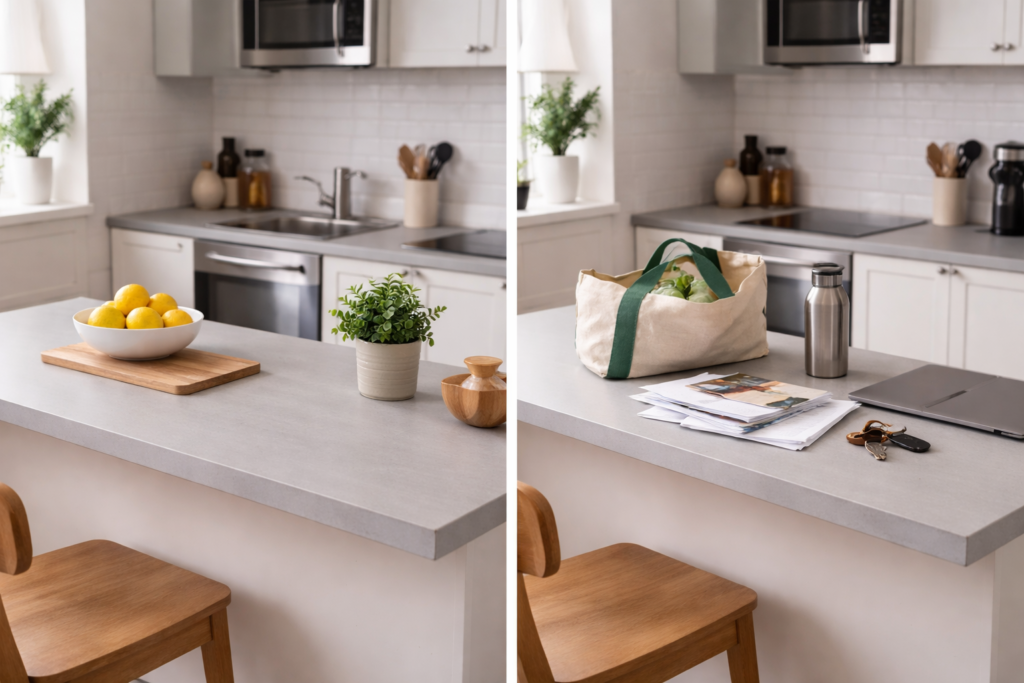
The first placement of the week often feels temporary. By the third repetition, that surface has quietly been promoted to a system. The body remembers the shortcut. The brain stops negotiating. What looks like carelessness is often just a fast decision made at low energy.
Energy Decline Shapes Behavior
Evenings change how people move through their space. After a full workday, decision tolerance drops. Small choices such as opening a drawer, sorting mail, or folding clothes feel heavier than they did in the morning.
In that state, the shortest path wins. If a counter is within arm’s reach, it absorbs the item. If storage requires bending, opening, stacking, or choosing between categories, it loses.
Visible Surfaces Carry Psychological Weight
Open, visible surfaces influence how a room feels. When they are clear, the entire space feels lighter. When they fill up, the mood shifts quickly.
That is why clutter hotspots often appear in high-visibility areas. They are not just practical drop zones. They are emotional amplifiers.
What Clutter Hotspots Reveal About Your Home’s Design
When clutter keeps returning to the same spots, it is usually exposing a design mismatch. The layout may look functional on paper, but daily behavior tells a more honest story. Homes stabilize when storage aligns with movement, timing, and energy. When that alignment slips, surfaces begin compensating.
Storage That Requires Too Many Steps
Pay attention to what it takes to “properly” put something away. If storing mail means walking to another room, opening a drawer, and sorting it immediately, most people will delay that action at 8:30 PM. If putting away a bag requires clearing space first, the bag will wait on the nearest chair.
Busy adults default to low-friction paths. When storage requires multiple steps during low-energy hours, flat surfaces become the temporary solution. Over time, temporary turns into routine.
Undefined Landing Spaces
Many clutter magnets form because nothing has an explicitly defined home. Keys float between counters. Reusable bags drift from chair to floor to dining table. Water bottles migrate based on who last used them.
When two adults share space, ambiguity multiplies. If neither person feels clear ownership over a landing zone, items linger longer than intended. The surface becomes a neutral holding area, and neutral holding areas tend to grow.
Mismatched Expectations Between Partners
One partner may see an item as parked for the evening. The other experiences it as accumulation. Neither is wrong. The friction appears because the home has not made expectations visible.
Clutter returning to the same spots often reflects unspoken assumptions. One person believes the counter is flexible space. The other experiences it as a high-impact surface. Without structural clarity, surfaces absorb the tension quietly.
Recurring clutter rarely signals a character flaw. It usually reveals a gap between design and behavior, or between two sets of expectations operating in the same square footage.
The Five Most Common Clutter Magnets in Busy Homes
Across small apartments and shared homes, the same zones tend to destabilize first. These surfaces sit at the intersection of traffic flow, fatigue, and shared use. When you identify them, you begin to see the structure behind the repetition.
The Entry Table
This surface absorbs transition. Keys, wallets, delivery packages, sunglasses, grocery bags, and mail all pass through this space within minutes of arriving home. If the entry lacks a defined landing rule, the table becomes a holding zone for anything that has not yet been processed.
The Kitchen Counter
Counters sit at the center of evening activity. Cooking, unpacking, sorting mail, filling water bottles, and charging devices often happen within the same square footage. When storage for recurring items sits even slightly out of reach, the counter carries the overflow.
The Dining Table
In many homes, the dining table doubles as a workspace. Laptops, notebooks, chargers, and paperwork stay visible because they will be needed again tomorrow. Over time, the table shifts from meal space to semi-permanent command center.
The Bedroom Chair
Clothes that are not fully dirty and not fully clean tend to land here. The chair becomes a decision buffer. Without a clear rule for in-between items, this surface slowly fills.
The Paper Stack Surface
Every home seems to have one horizontal space where paper gathers. Bills, receipts, school notices, and warranty slips land here because they require later action. Without a defined processing rhythm, the stack grows quietly.
When clutter returns to the same spots, it often follows these predictable zones. The surface itself is rarely the problem. The traffic pattern around it usually is.
How to Diagnose Your Own Clutter Pattern
Before changing anything, slow down and observe. Most couples try to fix clutter the moment they see it. That impulse is understandable, but it hides useful information. If the same surface fills every week, there is data there.
Notice Where Drift Begins
Walk through your home at the end of a normal weekday. Ask yourself three questions:
Where does clutter reappear first?
What specific items dominate that surface?
At what time of day does the accumulation usually begin?
Patterns tend to repeat within the same time window. Mail gathers after work. Clothes collect after changing. Dishes spread after dinner. When you connect the item to the time and location, the pattern becomes clearer.
Count the Friction Steps
Now examine what it takes to store those items properly.
How many physical steps are involved?
Does it require opening a drawer that is already full?
Does it demand sorting, folding, or choosing between categories?
If putting something away takes more effort than placing it on the nearest flat surface, behavior will follow the easier route. Busy adults do not avoid order on purpose. They avoid unnecessary friction.
Look for Ambiguity
Finally, ask whether the surface has a clearly defined purpose.
Is it understood as a flexible landing area?
Is it meant to stay clear?
Does one partner assume something different from the other?
When expectations remain unstated, surfaces become negotiation zones. Over time, negotiation zones accumulate items because no one feels confident clearing them decisively.
Diagnosis changes the tone of the problem. Instead of reacting to visible clutter, you begin reading the structure underneath it. That shift alone reduces tension and opens the door to more stable design choices.
The Structural Insight Most Couples Miss
Most couples treat recurring clutter as a maintenance problem. They assume they need to try harder, clean more often, or push through fatigue. That approach works briefly. Then the same surfaces fill again.
What usually goes unnoticed is how small structural mismatches compound across the week.
A counter without a clear boundary absorbs anything that arrives after 7 PM. A chair without a defined role becomes flexible storage. A drawer that barely closes discourages daily use. None of these feel dramatic in isolation. Together, they create predictable drift.
When clutter returns to the same spots, it is rarely about effort. It reflects where behavior and design have fallen slightly out of alignment. The home is still functioning, but certain surfaces are carrying work the system has not accounted for.
Busy couples often assume the solution requires a larger overhaul. In many cases, the insight is simpler. If a surface consistently destabilizes, that surface is not failing. It is compensating.
Once you view clutter hotspots as structural signals rather than personal shortcomings, the tone shifts. Conversations become less reactive. Instead of debating who left something out, you can ask what that surface is being asked to handle every evening.
That shift does not eliminate clutter overnight. It does make the pattern visible. And visibility is what allows homes to stabilize over time instead of resetting the same chaos every week.
If You Want to Prevent the Drift
Understanding why clutter returns to the same spots gives you clarity. Preventing that drift requires structure.
If this article helped you see your clutter hotspots differently, the next step is installing a simple weekly rhythm that keeps those surfaces from destabilizing in the first place.
We’ve created a practical 90-Minute Sunday Reset designed specifically for two working adults in a small apartment. It restores visible surfaces to neutral, reduces friction before the week begins, and prevents the same counters and tables from absorbing overflow again by Wednesday.
You can download it free and try it this weekend. It’s a straightforward system built around real energy levels and shared spaces, not perfection.
If, after that, you feel ready to install a more comprehensive structure across your week, the 7-Day Home Reset Framework builds it step by step. It helps you define zones clearly, assign ownership deliberately, and lock in a repeatable rhythm that prevents drift.